





runDisney from Canada: how the races and the registration really work
A runDisney race means crossing the start line at 5 a.m. in an EPCOT parking lot and running through theme parks before breakfast. The hard part is not the distance. It is getting a bib, because registration opens roughly ten months before race day and the popular distances fill within hours.
That is why we hold runDisney registrations in advance for our clients. More on that below. First, the system itself, because a bib is worthless if the rest of the trip is built badly.
What is runDisney?
runDisney is Disney's running division. It stages four race weekends a year at Walt Disney World Resort in Florida, plus one in Europe, the Disneyland Paris Run Weekend.
Each weekend bundles several races over three or four days: a 5K, a 10K, a half marathon, sometimes a full marathon, and challenges that string two or more races together. Courses run through the parks before they open to the public, past the castle at Magic Kingdom Park and along the EPCOT pavilions, with characters posted along the route for photos.
These are real timed races, with start corrals and an enforced minimum pace. The atmosphere is festive. The logistics are not.

Cinderella Castle at Magic Kingdom Park. All four runDisney weekends are run at Walt Disney World Resort in Florida. ©Disney
The 2026-2027 race weekends in Florida
- Disney Wine & Dine Half Marathon Weekend, October 22 to 25, 2026: 5K, 10K, half marathon (21.1 km) and the Two Course Challenge, which combines the 10K and the half for 31.1 km.
- Walt Disney World Marathon Weekend, January 6 to 10, 2027: 5K, 10K, half marathon, marathon (42.2 km), Goofy's Race and a Half Challenge (63.3 km) and the Dopey Challenge (78.3 km).
- Disney Princess Half Marathon Weekend, February 25 to March 1, 2027: 5K, 10K, half marathon and the Fairy Tale Challenge (31.1 km).
- runDisney Springtime Surprise Weekend, April 15 to 18, 2027: 5K, 10K, 10-miler (16.1 km) and a challenge combining the last two (26.1 km).
January's Marathon Weekend is the flagship. The Dopey Challenge means running all four distances on four consecutive mornings, 78.3 km in total. Goofy pairs Saturday's half with Sunday's marathon.
Nothing in California this season. Disneyland Resort races are on hiatus because of construction tied to the DisneylandForward expansion. Runners who had Anaheim in mind need to look at Florida or Paris.
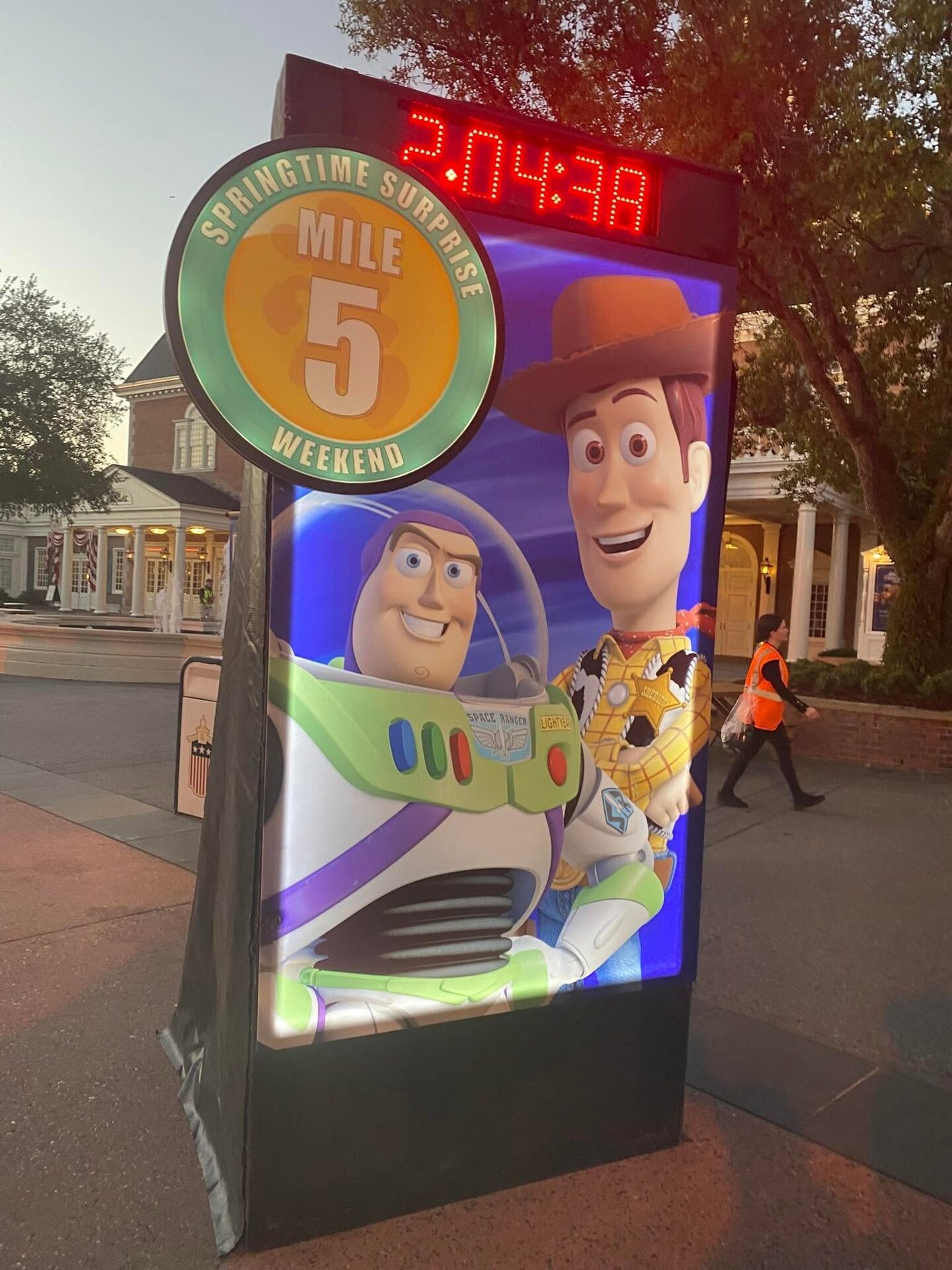
The mile 5 marker at dawn during Springtime Surprise weekend. Photo Voyages AquaTerra. ©Disney
Why registration is the real start line
Registration for a race weekend opens roughly eight to ten months ahead. For January 2027's Marathon Weekend it opened on March 17, 2026. For the February 2027 Princess weekend, on June 2, 2026. The most popular distances sell out within hours, and you need to be at your screen at the exact opening time.
Three rules make it tighter still.
Registration fees are not refundable. Disney states it plainly: registration fees, commemorative items and event-related purchases are non-refundable.
Bibs are not transferable. Not between people, not between race weekends, and not to an event that has reached capacity. An injury in December costs you the entry, though not necessarily the trip, which is exactly what proper cancellation insurance covers.
A bib without a room is a problem. Hotels in the area fill for these weekends too, and your hotel choice has a direct effect on your race, as you will see below.
How to get a bib without racing the clock
We hold runDisney registrations in advance, so our clients are not fighting a countdown on opening morning.
In practice, the entry comes with booking your trip through one of our Créateurs de Magie, our Disney travel specialists. The bib is part of the travel booking: race, hotel and park tickets are built together, by the same person, on the same dates. You end up with neither a race and no room, nor a room and no race.
What that changes: you are not at your keyboard at a precise hour eight months out on a Tuesday morning in March. You pick your hotel around the race rather than around what is left, and when the gun goes at 5 a.m. that is no small thing. And you are talking to someone who follows the runDisney calendar and knows which races go first.
Held registrations are limited and vary by weekend, so the useful reflex is the same as for the race itself: talk to us early, ideally a full season before the one you are targeting.
Corrals and proof of time
Runners are assigned to start groups, the corrals, marked by a letter on the bib.
For the 5K and 10K, placement follows the pace you declare at registration. No proof is required.
For the half marathon and the marathon, Disney asks for proof of time: a result from an officially timed race. For the marathon, a 10-miler, half or full marathon is accepted. For the half, a 10K, 10-miler, half or full marathon. Disney explicitly refuses self-timed runs, training runs and virtual races.
Proof is only required if you are claiming a marathon in 5 hours or less, or a half in 2:30 or less. The deadline falls several months before race day. Without verified proof submitted on time, you are placed in the last start group, which for a 5 a.m. race can mean an extra hour standing in a parking lot and a finish under a sun that is already high.
For a Canadian runner, this reshapes the training calendar. You need a timed race in Ontario or Quebec the previous summer or fall to be seeded properly in January. That is one more race to plan, often a year ahead.
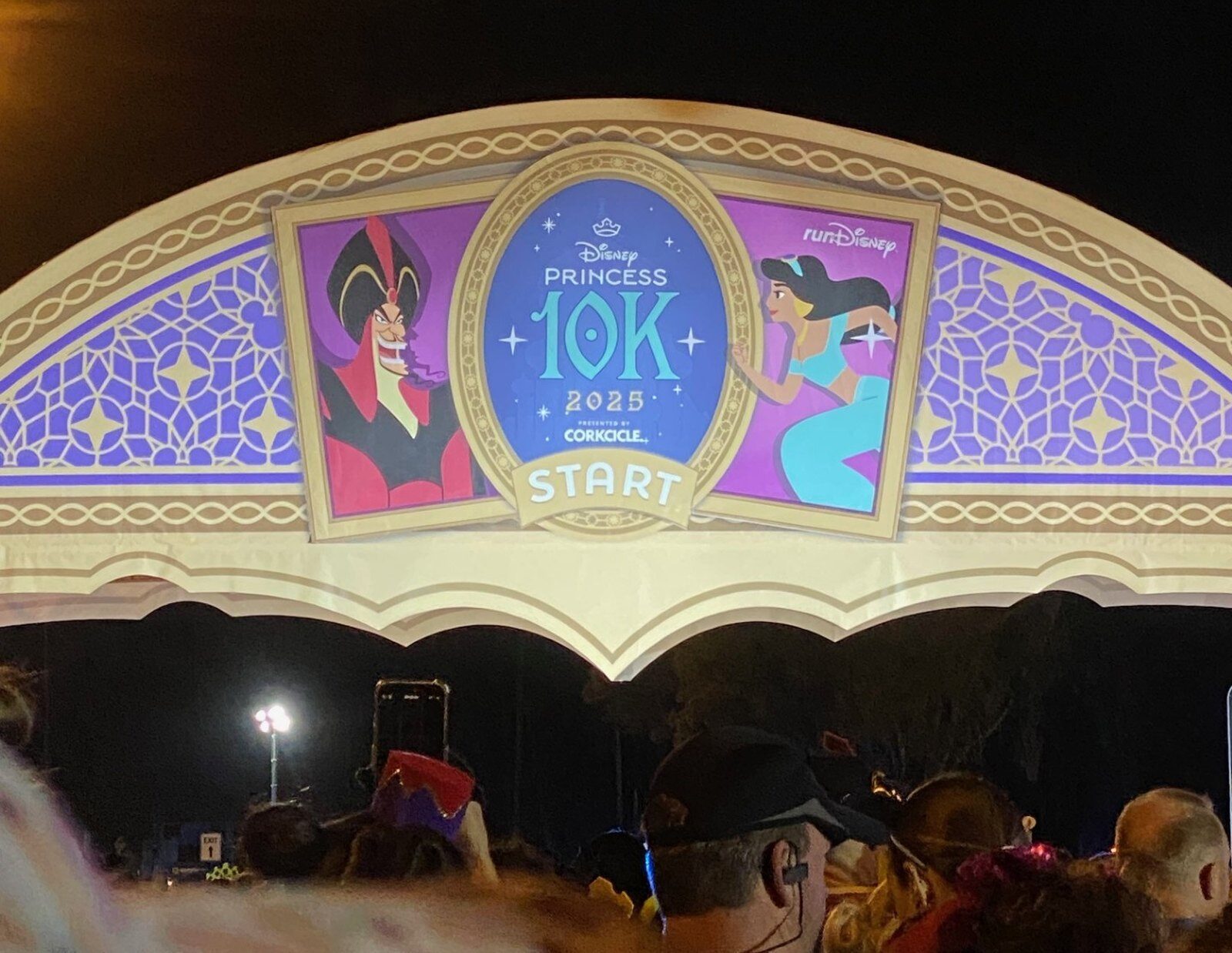
The Disney Princess 10K start, before sunrise. Photo Voyages AquaTerra. ©Disney
The minimum pace
runDisney enforces a minimum pace of 16 minutes per mile across all distances, which works out to roughly 9:56 per kilometre. It is a brisk walking pace, reachable for many people, and it is genuinely enforced. The clock starts when the last runner crosses the start line, not when you do. Sweepers close the course at that pace, and runners who are caught finish by bus rather than across the line.
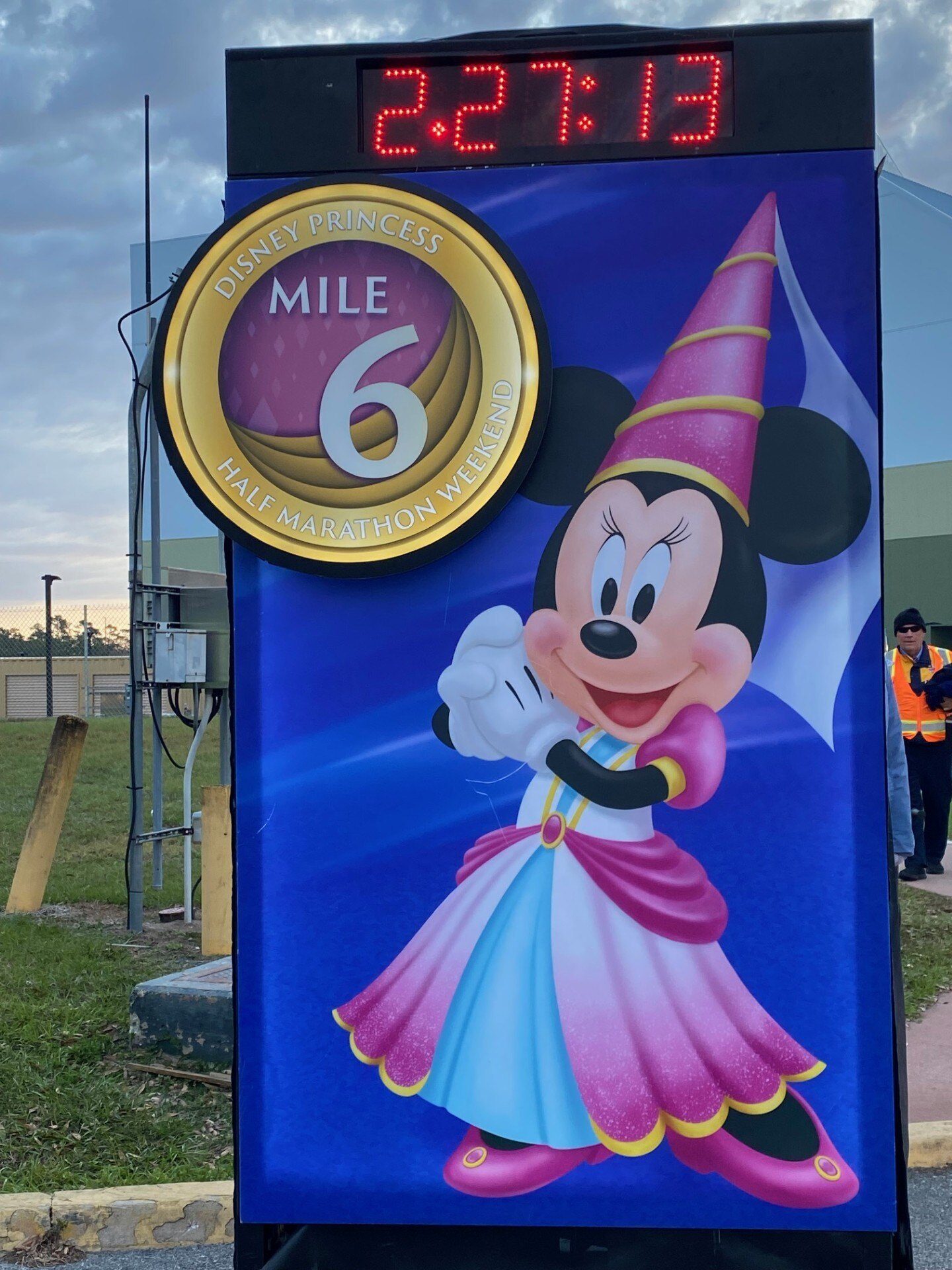
The race clock at mile 6 of the Disney Princess Half Marathon. Photo Voyages AquaTerra. ©Disney
Minimum ages follow the distance: 5 for the 5K, 10 for the 10K, 14 for the half marathon, and 18 for the marathon and for the Goofy and Dopey challenges.
Training through a Canadian winter for a Florida race
Here is the part American running blogs do not write, because it only applies to runners from the north.
You build a January marathon on long runs from October to December, often below freezing, sometimes on ice, in three layers. On race morning you start at 5 a.m. in a Florida that routinely sits between 18 and 22 °C with very high humidity, and the sun comes up while you are still running. A body trained in the cold loses cooling efficiency in those conditions, and the pace that felt easy in training turns heavy at the 25-kilometre mark.
Three adjustments, all of which need to be planned before you book. Arrive at least two days early rather than the night before, which buys a little acclimatisation and protects you against a delayed flight. Revise your time goal downward, because a marathon run in Florida humidity does not compare to one run in October at home. And put one overheated indoor session or overdressed run in the final weeks, so your body has met the heat at least once.
What the race does to the rest of the trip
A 5 a.m. start decides your hotel. Buses to the staging area begin running around 3 a.m., and runners are advised to be on site by roughly 4 a.m. A Disney Resorts Collection hotel includes that transport, which beats driving and parking at 3:30 with a bib pinned on. Hotel choice becomes a race decision rather than a comfort question.
Race morning transportation — the bus you need to catch long before the start. Photo Voyages AquaTerra. ©Disney
The expo is mandatory. Bibs, shirts and gear bags are collected at the expo at ESPN Wide World of Sports Complex before the race, so you need to arrive early enough to get there, and expect lines on the first day.
Plan fewer park days. A guest who wakes at 3 a.m. and runs 21 or 42 km does not spend the afternoon in queues. For a five-night trip with one race, count on two real park days rather than four. That is also what makes the Disney hotel planning advantages more valuable than usual: when park time is short, buying Lightning Lane seven days ahead instead of three changes the day.
The Dopey Challenge takes four mornings. Four pre-dawn alarms, four races, and nothing else serious on the schedule. This is a trip built around the race, not a family holiday with a race attached.
Europe: the Disneyland Paris Run Weekend
There is a fifth race weekend, also run by runDisney, at Marne-la-Vallée outside Paris, historically held on the third weekend of September.
The races: a 5K, a 10K, a half marathon, a 31 km challenge combining the 10K and the half, and a 36 km challenge covering all three. Children's races are included. One particular challenge, the Castle to Chateau Challenge, rewards runners who complete a race at Walt Disney World Resort in Florida and another at Disneyland Paris in the same year.
The event grew quickly: 15,000 participants at the first edition in 2016, including 8,595 in the half marathon, then just over 20,000 in 2017, 26,000 in 2018 and 27,000 in 2019. The September 2020 edition was cancelled because of the pandemic.
Courses run through Parc Disneyland and Disney Adventure World. The 2027 dates were not confirmed at the time of writing, so confirm them before booking anything.
Where to start
Pick the weekend and the distance first. Check whether you hold valid proof of time, and if not, enter a timed race near home, because that result decides your corral. Then talk to us, ideally a season before the one you are targeting, so the race, the hotel and the tickets are built together. And keep two realistic park days on the schedule rather than four theoretical ones.
Our Créateurs de Magie follow the runDisney calendar and hold registrations in advance. For the rest of the trip, see our Walt Disney World Resort in Florida packages and our guide to choosing where to stay.
Disney images, logos and properties: ©Disney.


