
The French Cheese Route
Three regions are enough to understand French cheese: Normandy for the milk of damp pastures, Auvergne for volcanic cellars, Savoie for summer alpine pastures. They can be visited separately or strung together, and the last question of the trip — what may you bring home — has a stricter answer than most travellers expect.
What does a PDO actually change?
A protected designation of origin is not a quality label, it is a geographic specification. It sets the production zone, the breed of cow or sheep, what they eat, the milking season, the minimum ageing time and sometimes the shape of the wheel. A Camembert de Normandie PDO and a cheese sold simply as "camembert" are two different products, and only the first name is protected.
Raw milk or pasteurised — the difference that matters on the way home
Raw milk is not heated, which preserves the natural bacteria of the place and gives the cheese a complexity pasteurisation erases. That is why a cheese bought at a French farm has no equivalent on a Quebec grocery shelf. It is also what complicates the return trip, as we will see.
Normandy — the country of milk
The Pays d'Auge holds three PDOs inside a forty-kilometre triangle: Camembert de Normandie, Livarot and Pont-l'Évêque. The landscape explains the cheese — rich pasture, apple trees, constant damp and Normande cows with their brown eye patches. Farms that sell direct often signal it with nothing more than a hand-painted board at the roadside.
Auvergne — volcanoes and cellars
Cantal and Salers are among the oldest cheeses in France, still made in enormous wheels aged for months. Further south, Roquefort matures in natural caves in the Combalou plateau, ventilated by fissures in the rock called fleurines. Visiting those caves is one of the few genuinely spectacular cheese experiences anywhere.
Savoie — the alpine cheeses
Here the season matters more than the region. Summer milk, from cows taken up to alpine pasture and fed on fresh grass, does not make the same Beaufort as winter milk. Summer Beaufort even carries its own distinct marking. Reblochon, Abondance and Tomme complete the family.
Where to buy — markets, farms and affineurs
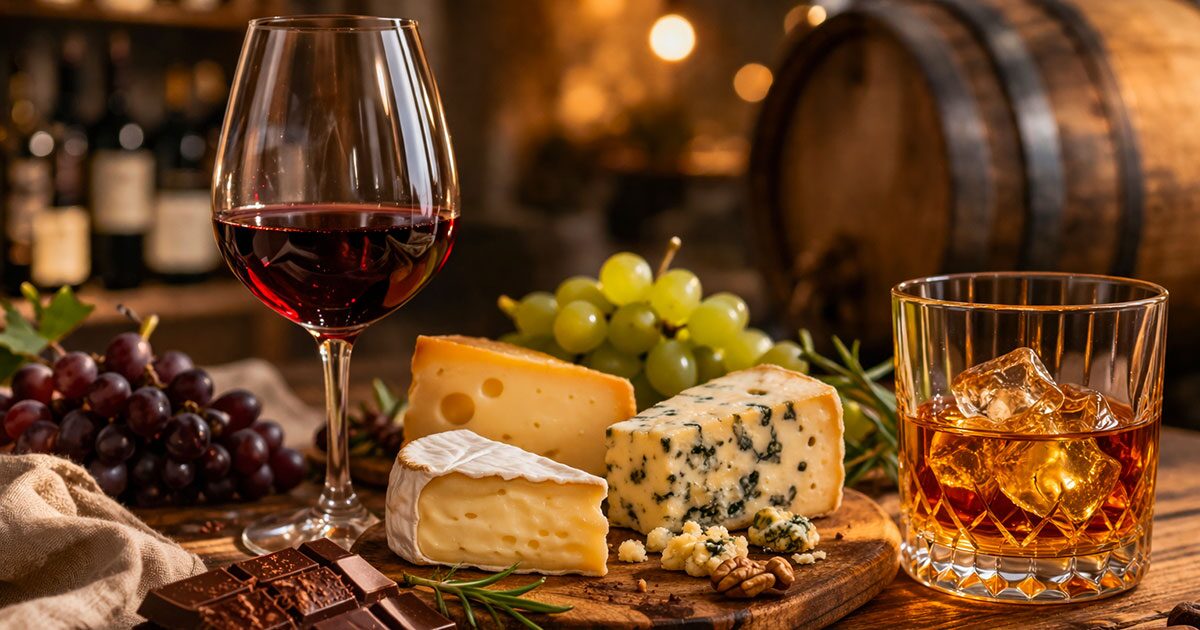
Three routes, three experiences. The morning market, where you taste before buying and the seller knows which farm each wheel came from. Direct farm sales, the most rewarding but requiring driving and sometimes a phone call. And the affineur, a French trade in its own right: someone who buys young cheese and ages it in their own cellars. That is where the finest pieces are found. Cheese calls for wine: our wine routes combine naturally with this trip.
Can you bring cheese back to Quebec?
This is the question everyone asks at the end of the trip, and the answer surprises people. The Canadian Food Inspection Agency sets the limit at 20 kg or 20 litres of dairy per person — a quantity nobody reaches. But a second rule is far more restrictive: for a traveller arriving from anywhere other than the United States, only pasteurised cheeses are admitted. Raw-milk cheeses are allowed only from countries recognised as free of certain animal diseases.
In other words, the raw-milk camembert bought at the farm, the one that justified the trip, is precisely the one at risk of being refused. The rules and the country list change: check the current position on the CFIA site before you go, and always declare what you are carrying. An honest declaration costs the cheese at worst; failing to declare costs a fine.
When should you go?
Spring and autumn. In Savoie the alpine pastures are only occupied in summer, but summer cheeses are eaten after ageing, so later in the year. In Normandy and Auvergne the season matters little to the cheese itself, but a great deal to your comfort: the cellars are cold and damp year-round.
Organising the trip from Quebec
The three regions do not combine easily in a week — Normandy lies west of Paris, Auvergne in the centre, Savoie east towards the Alps. Two regions per trip, with the train to your entry city and a car from there, gives a more honest pace. An adviser can line up the route, the farms that receive visitors and the nights in guesthouses.
Voyages AquaTerra holds a Quebec travel agency licence. Our clients are covered by the Compensation Fund for Customers of Travel Agents, under the conditions set out in the regulation. Call an adviser at 1-866-628-6241. Burgundy grafts neatly onto a cheese route — see the Burgundy wine route.


