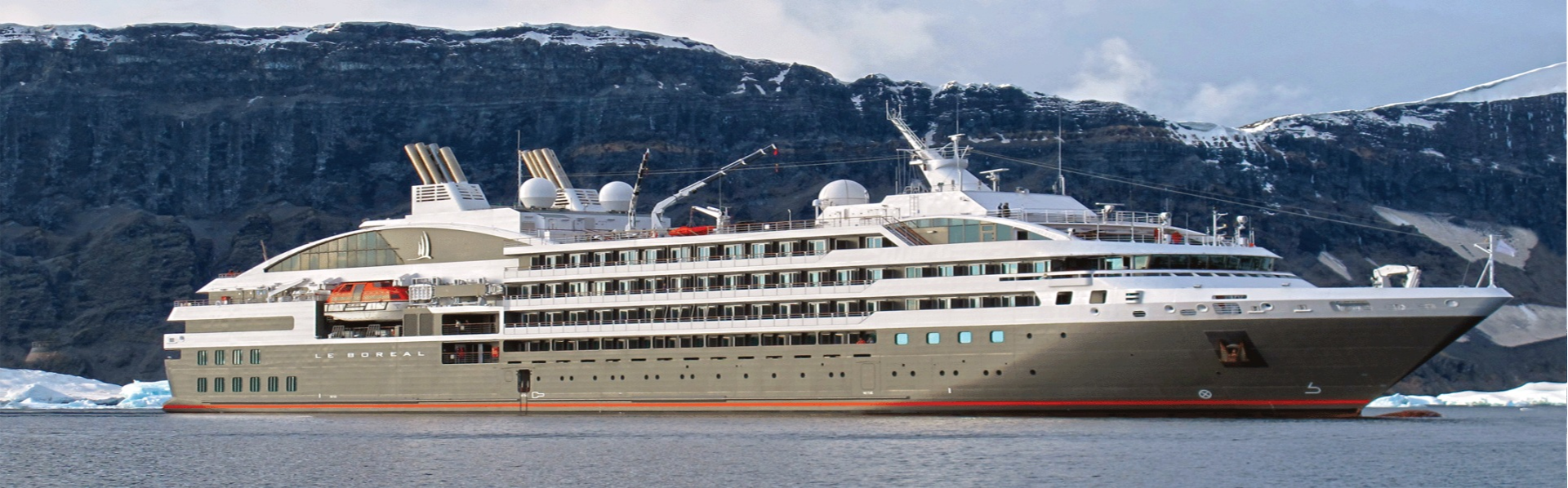
The first hull of the series
Le Boreal belongs to the series the line calls its Sisterships: four identical
hulls delivered between 2010 and 2015, built to carry from two hundred and
twenty-four to two hundred and sixty-four guests. It is the fleet's middle
format, larger than the exploration ships and far smaller than anything else
being built at this end of the market.
She entered service in 2010. Departure dates are on sale in 2026, 2027 and 2028.
What this format allows
Guest numbers decide what an itinerary can hold. Under two hundred and fifty
people, a ship enters ports closed to large hulls, lands everyone in a single
rotation of zodiacs, and works up fjords and channels where the big ships do
not go. That is this fleet's reason for being, and it is verified on the
itineraries rather than in the brochures.
The number of wheelchair-accessible staterooms is published for
no ship in this fleet. We check it at booking rather than quote a figure.
What is included, and the one thing that is not
This line is generous, and generous in an order that surprises. Shore
excursions are included. Most drinks are too, prestige wines aside. Wi-Fi is
included. The stateroom minibar is included. Talks and entertainment are
included. A butler comes with the suites.
Gratuities are not included. That is the exact reverse of
what most guests assume: they expect to pay for the shore outings and to find
tips prepaid, and the opposite happens. Budget for it, because nothing aboard
will remind you before the end of the stay.
Spa treatments are charged as well. For the rest, the formula holds what it
promises, and on an itinerary with many calls the included excursions weigh
heavily in the comparison.
Meanwhile, in the fleet
The series holds three more hulls: L Austral, Le Soleal and Le Lyrial. The fleet also holds six exploration ships, an icebreaker, a three-masted yacht and a catamaran.
Booking from Quebec
This line's contract is the most favourable we have read in the sector, and
that deserves saying plainly. The carrier is Compagnie du Ponant, based on
avenue du Prado in Marseille, and the contract is governed by French
law. A dispute goes before the competent French courts.
What is missing matters as much as what is there. No arbitration
clause. No class-action waiver. The American
contracts of several competitors impose both, obliging every guest to plead
alone before an arbitrator the carrier chose. Not here.
The deadline follows the same logic. Claims are time-barred after
two years, where other lines allow only fifteen or thirty days
from disembarkation. The Athens Convention of 1974, consolidated in 2002 and
carried into European regulation 392/2009, frames liability. A tourism mediator
exists and can be called on.
Two honest caveats. The line declines all liability for baggage left
unattended, and reserves the right to alter the itinerary or substitute the
means of transport under operational constraint. Also, the conditions we read
are the French general conditions: which version applies to a file opened here
is verified case by case. Your Quebec protection does not depend on that:
Voyages AquaTerra holds a licence from the Office de la protection du
consommateur, your payments pass through a trust account, and your departure is
covered by the compensation fund for travel agency customers.