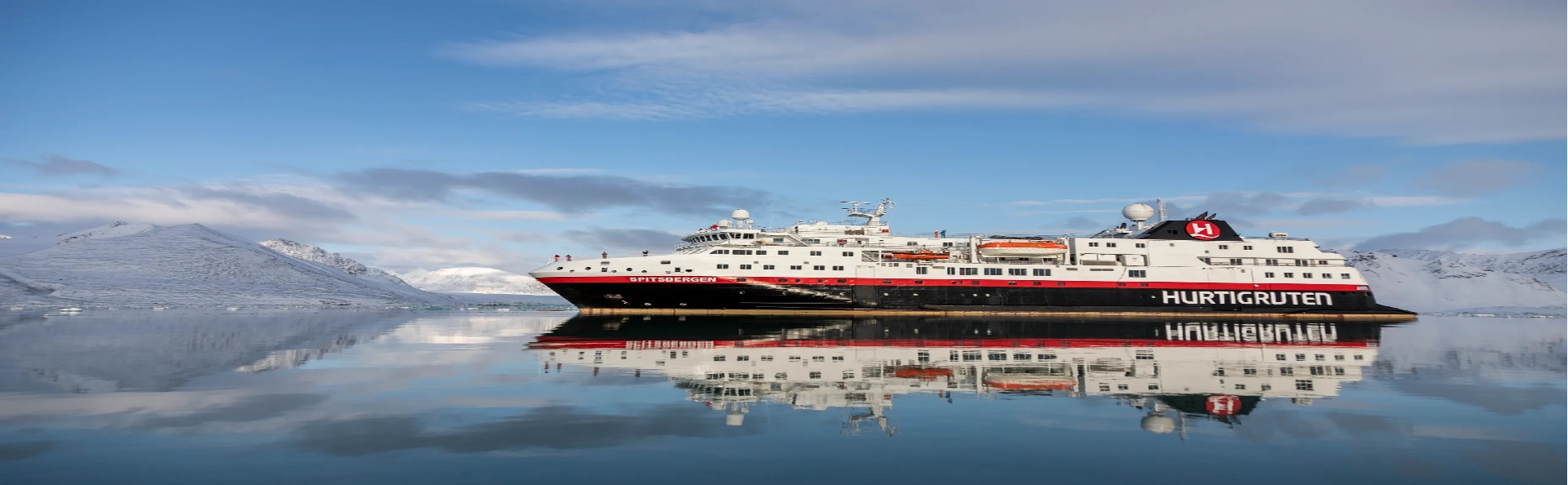
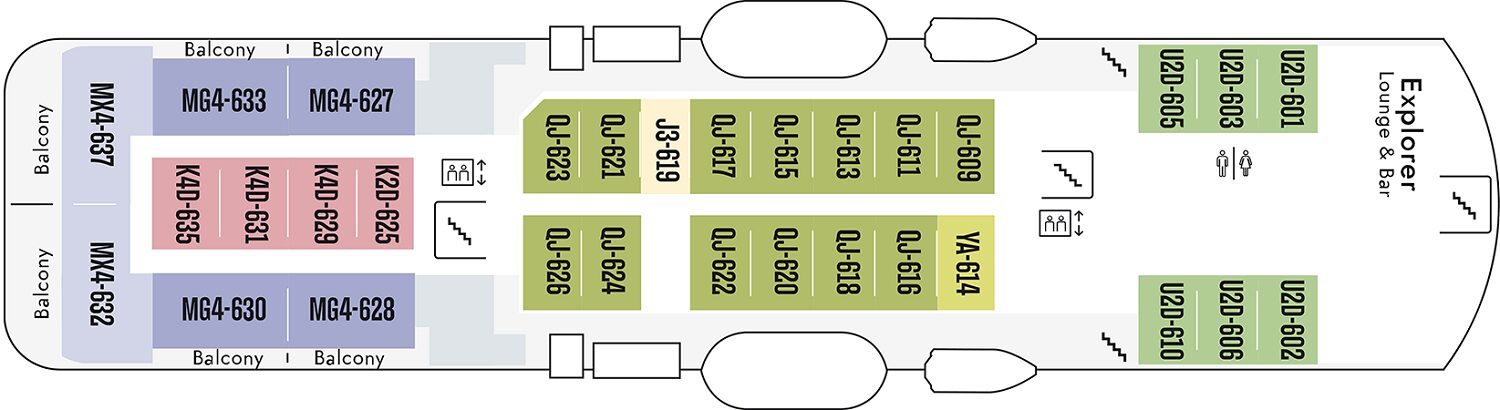
An Azores ferry that became a polar ship
The MS Spitsbergen was not designed for expedition work. She left the
Estaleiros Navais yard at Viana do Castelo, Portugal, in 2009 as the MV
Atlantida, a ferry ordered for the Azores. She never served that route.
Hurtigruten bought her in early 2015, converted her into an expedition ship
with a strengthened hull, and christened her on 8 July 2016 at Svolvaer,
Norway, with the polar explorer Cecilie Skog as godmother.
This is not a historical footnote. A converted ferry does not have the same
profile or the same outdoor space as a hull drawn for ice. In exchange she is
compact, one hundred and one metres by eighteen, which lets her anchor where
larger ships cannot.
What we cannot establish
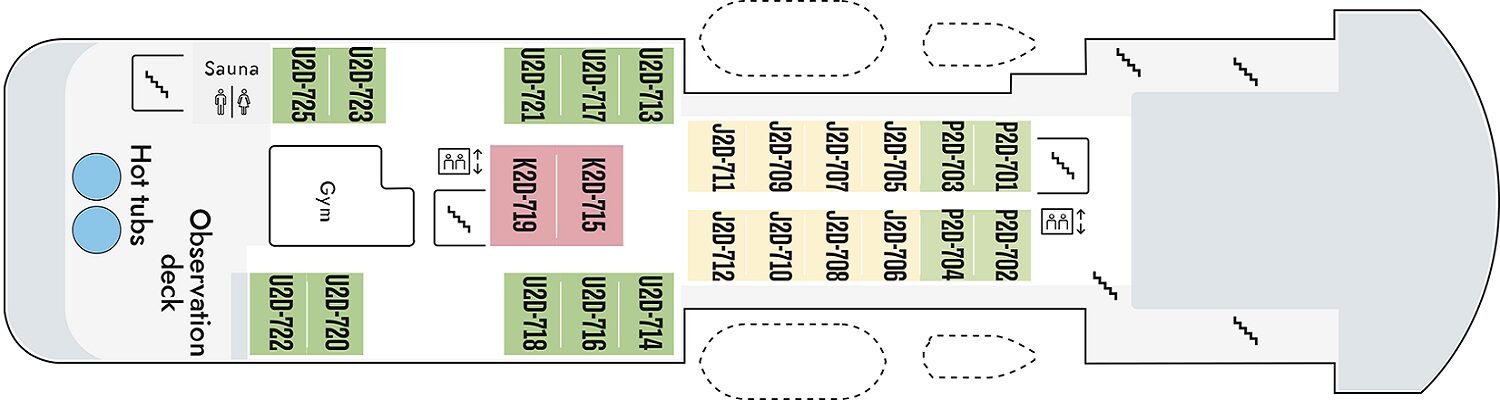
The cabin count is not settled. One specialist database says one hundred and
eighty, another speaks of about a hundred after the conversion. Both may
describe two states of the same ship; nobody says so. The same gap applies to
capacity: the operator states one hundred and fifty guests, databases go above
three hundred, which looks like a maximum certificate. The number of adapted
cabins is published nowhere for this hull. We ask for it on each booking rather
than putting forward a figure.
Two refits are documented, in 2020 and in 2025. The second rebuilt the
bathrooms in the polar cabins, expanded crew areas and added a science centre
and a new restaurant.
What is included, and what the operator says about it
This needs care, because the company is not careful. In March 2024 it
announced all-inclusive fares across the fleet from that November. Its
MS Spitsbergen page today lists daily excursions, the science centre, meals,
gratuities and drinks, with an asterisk whose footnote appears nowhere on the
page. Its own frequently asked questions reserve gratuities for suite guests
and describe most excursions as optional, booked separately. Its terms and
conditions exclude premium drinks except in suites.
Three texts, three versions. So we promise nothing on its behalf. What is
stable across all three: full board, house drinks at lunch and dinner, tea and
coffee all day. What is not: gratuities, excursions, premium drinks and Wi-Fi,
announced as free but limited, with paid packages beyond that. Ask for the
written list for the departure you choose. It is the only way to know.
Accessibility: what the operator writes
The ships are declared wheelchair accessible, with conditions. Guests bring
their own wheelchair, and it must be no wider than sixty centimetres. The
operator also writes that you must be reasonably agile to board the inflatable
boats, because that is how expedition landings happen, not by gangway. Anyone
who needs help with that transfer should know before booking, not on the day
of the landing.
Rubber boots are provided where they are mandatory, in Antarctica, Svalbard
and East Greenland. Hiking boots are not. Antarctic voyages require a medical
form completed six weeks before departure. The minimum age is five for
Antarctica and Galapagos, and landings for children under twelve are at the
captain's discretion. Nobody may travel who will be twenty-four weeks pregnant
or more by the end of the voyage.
The rest of the fleet
The MS Fram is the other small ship in
the fleet, with a more conventional history. The
MS Roald Amundsen shows what a hull drawn for
expedition work from the start can do. And the
hull that left this fleet in 2024 tells the
opposite story.
Booking from Quebec
The contract for departures sold in the Americas is with HX US Inc, a
Delaware company. It is governed by English law and names the courts of
England to the exclusion of all others. There is no arbitration clause and no
class-action waiver, which serves you better than what several other lines
write. The deadlines are short: two years for personal injury, death or
luggage, one year for everything else. Away from US ports the Athens
Convention caps liability; otherwise it is capped at three times the total
booking price.
The operator also reserves the right to change the route, alter landings,
substitute a ship or cancel for force majeure. On an expedition that is not
boilerplate: ice and wind decide the day more often than the schedule
does.
Nothing establishes a Quebec licence for this operator. Your protection
comes from here: Voyages AquaTerra holds a licence from the Office de la
protection du consommateur, your payments pass through a trust account, and
your departure is covered by the compensation fund for travel agency
customers.