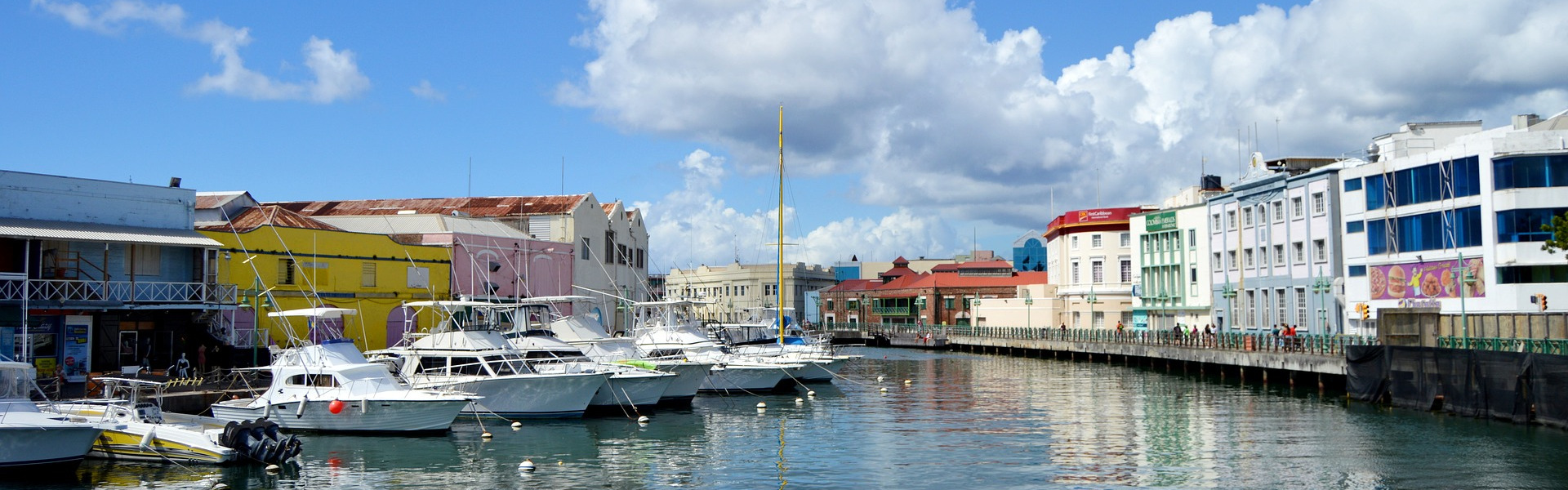
Bridgetown is the capital of Barbados and one of the oldest English towns in the Americas, founded in 1628. Its historic centre and its garrison were jointly listed as UNESCO World Heritage in 2011. You spend half a day there on foot, and you find two or three things you see nowhere else in the Caribbean.
The essentials in four lines
- About five hours on a seasonal non-stop from Montreal to Grantley Adams (BGI), thirty minutes from the centre.
- Barbados is one hour ahead of Montreal in winter and on the same time in summer.
- The Barbados dollar is pegged to the US dollar at two to one, and both circulate.
- Driving is on the left. The town is walkable; the beaches are fifteen minutes either side.
The historic centre
Everything starts at the Careenage, the small inner harbour where ships were once careened, now lined with restaurants and crossed by a lift bridge.
Around National Heroes Square stand the Parliament buildings, completed in 1874 in a neo-Gothic style, with stained glass depicting the British sovereigns. Barbados has the third oldest parliamentary assembly still sitting in the world, meeting without interruption since 1639.
Two streets away is the Nidhe Israel synagogue, founded in 1654 by Sephardic Jews arriving from Brazil. It is among the oldest in the western hemisphere, and its seventeenth-century ritual bath, rediscovered during excavations in 2008, is visited along with the adjoining museum.
The garrison
Ten minutes south, the former British garrison keeps its parade ground, now a racecourse, its eighteenth-century military buildings and the largest collection of seventeenth-century cannon preserved anywhere in the world.
This is also where the house stands in which George Washington stayed in 1751, aged nineteen, accompanying his ailing half-brother. It was his only journey outside what would become the United States, and he caught smallpox there, which left him immune for the rest of his life. The house is open to visitors.
Carlisle Bay
The town beach, five minutes on foot from the centre, closes a bay where six wrecks lie between five and ten metres down. All are visited by snorkel from a boat, minutes from shore, and hawksbill turtles regularly come close.
It is one of the few Caribbean capitals where you can tour a nineteenth-century parliament in the morning and swim over a wreck in the afternoon.
Rum
Barbados claims the invention of rum: the first distillations of molasses are documented here in the 1640s, and the oldest commercial brand still operating dates from 1703. The distillery is visited north of town, with tastings.
More interesting still, the island has hundreds of rum shops, the small neighbourhood establishments that serve as bar, grocery and meeting place. It is a social institution, and the best ones are off the circuits.
Where to stay, where to go next
People rarely stay in Bridgetown itself. The west coast, north of town, is the leeward side: flat water, pale sand, upper-tier hotels, and practically no sargassum. The south coast, around Dover and St Lawrence Gap, is livelier and more affordable.
To the east, the Atlantic coast at Bathsheba is spectacular and unfit for swimming: swell, currents and rock. You go there to walk and to watch surfing.
Our criteria for choosing an all-inclusive hotel help decide between the two coasts according to what you want.
When to go
From December to May the air holds around 29 °C, the trade winds blow and rain is rare. That is the Quebec high season.
From June to November, heat and humidity climb and showers turn daily but brief. Barbados sits at the eastern edge of the Antillean arc and statistically takes fewer hurricanes than its neighbours, without escaping them. Our guide on when to travel south from Montreal sets out the pricing calendar.
To plan this trip, see also our Barbade page, Dover and our month-by-month calendar.


