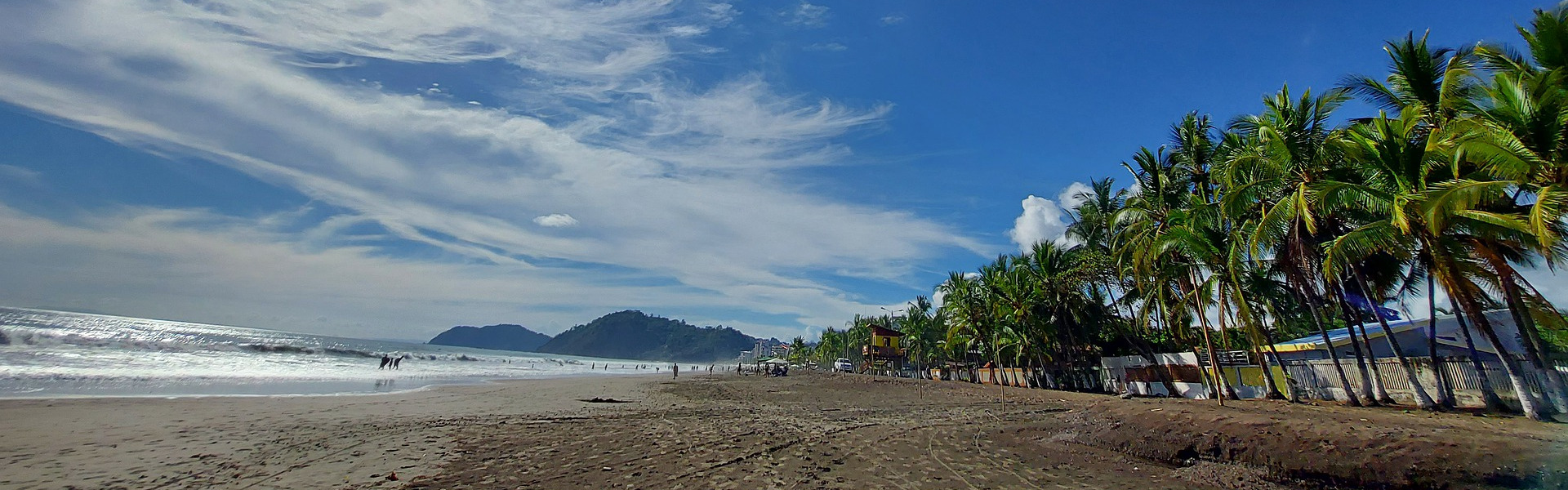
Jacó is the closest beach to San José: an hour and a half from the capital, which makes it the weekend destination of Costa Ricans. Three kilometres of dark grey volcanic sand, a wave that works year-round, a main street lined with shops and the most active nightlife on the Pacific coast. It is not a postcard, it is a real seaside town.
The essentials in four lines
- Fly into San José (SJO), then an hour and a half by road. From Liberia, count two and a half hours.
- Costa Rica runs one hour behind Montreal in winter and two in summer.
- No sargassum. The sand is volcanic grey, not white.
- December to April is the dry season. Green season from May to November, wetter than in Guanacaste.
The beach and the surf
Jacó bay takes swell year-round, with waves breaking over a sand bottom: that is what makes it good learning ground. A dozen schools rent boards and teach by the hour, and the wave stays rideable even on small days.
One instruction to take seriously: rip currents are frequent on this beach, particularly near the rocks at either end and on a falling tide. Swim in front of the lifeguard stands and stay out on big days if you are not confident.
Five minutes south, Playa Hermosa is another matter entirely: a powerful, hollow wave that hosts international contests, for experienced surfers only. From July to December, olive ridley turtles nest there at night, and a local project supervises hatchling releases.
Ten minutes north, Playa Herradura bay is far calmer, with a marina and a sportfishing fleet.
What lies around
Carara park
Twenty minutes north, this park protects a transition forest between the dry north and the wet south, which explains its unusual diversity. Above all it is one of the best places in the country to see scarlet macaws in the wild, at dawn and dusk.
Just before the entrance, the Río Tárcoles bridge overlooks a river where some thirty American crocodiles, several of them four metres long, lie on the sandbanks. You watch them from the bridge, free of charge.
Manuel Antonio
An hour south, Costa Rica’s most visited national park combines forest and beaches within one perimeter. You see sloths, capuchin monkeys, squirrel monkeys and iguanas within two or three hours on the trails. Go early: entry is capped and the car park fills.
Outdoor activities
Ziplines over the canopy, waterfall rappelling, quad bikes in the hills, catamaran trips: the offering is dense and prices lower than in Guanacaste. The Cerro Miro trail, at the edge of the village, climbs in an hour to a viewpoint over the whole bay.
The town
Jacó runs along one avenue parallel to the beach, with restaurants, supermarkets, surf shops and some thirty bars. It is the liveliest resort town on the coast, and its nightlife has a reputation that does not suit every traveller.
Families and couples looking for quiet generally stay at Playa Herradura, at Playa Hermosa or in the hillside residences south of town. During the day the question does not arise.
Accommodation
The supply consists mainly of condos, aparthotels and mid-category hotels sold without meals, with one or two properties offering an all-inclusive plan. Costa Rica’s large all-inclusive resorts are found rather in Guanacaste, two and a half hours north.
Since the town has dozens of restaurants within walking distance, room-only makes sense here. Our criteria for choosing an all-inclusive hotel help compare the two formats against your plans.
When to go
From December to April the sky stays clear and the air holds around 32 °C. That is high season and the driest period.
From May to November, late-day showers become daily and the vegetation goes wild. The central coast is markedly wetter than Guanacaste: September and October are frankly rainy, but mornings often stay clear and prices fall. Our guide on when to travel south from Montreal sets out the pricing calendar.
To plan this trip, see also our Costa Rica page, El Jobo, Islita and resorts that suit families.


