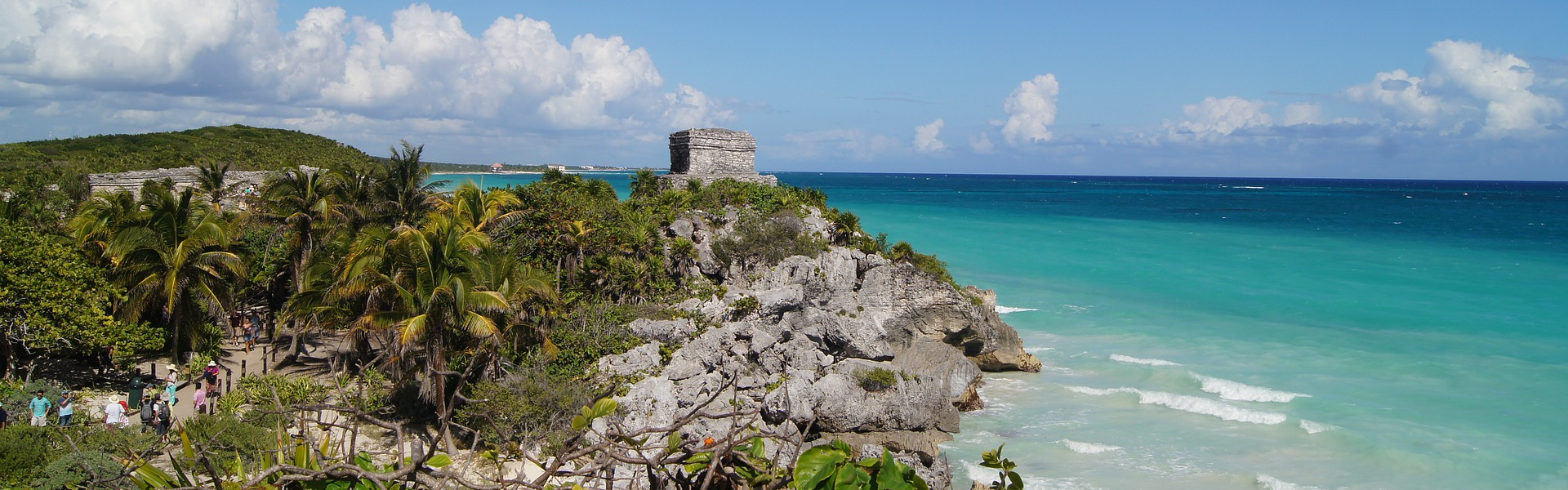
The Riviera Maya runs about a hundred and thirty kilometres south of Cancún, from Puerto Morelos to Tulum. Unlike the Cancún hotel zone, it has no centre and no numbering: it is a succession of villages, gated estates and beaches separated by low jungle and by Federal Highway 307. Which sector you choose sets your transfer time, the kind of beach you get and the feel of the trip.
The essentials in four lines
- Non-stop Montreal to Cancún in about four hours twenty, then twenty-five to a hundred minutes by road depending on the sector.
- A valid Canadian passport; no visa for a tourist stay.
- The second largest barrier reef in the world runs along the coast, a few hundred metres offshore.
- December to April is the dry season. Sargassum mainly from March to October.
Choosing your sector
Puerto Morelos
Twenty-five minutes from the airport, a genuine fishing village with its square and its leaning lighthouse. The reef passes five hundred metres offshore and forms a national park: the water is calm and you can snorkel straight from the beach. It is the quietest sector and the shortest transfer.
Playa del Carmen and Playacar
Fifty minutes from the airport. Fifth Avenue, pedestrianised for four kilometres, lines up restaurants, shops and terraces; the ferry to Cozumel leaves from the central pier. Playacar, just to the south, is a gated residential and hotel estate, quieter, with a golf course. A good choice if you want to walk out in the evening.
Puerto Aventuras and Akumal
An hour to an hour and fifteen. Puerto Aventuras is built around a marina; Akumal, whose name means place of turtles in Maya, holds a bay where green turtles graze the seagrass metres from shore. Access to the bay is regulated: life jacket required, guide, limited number of swimmers.
Tulum
An hour and a half to a hundred minutes. The most fashionable sector and the most expensive per metre of sand, with small hotels along a narrow coastal road. The Maya ruins overlook the sea from a twelve-metre cliff: the only Maya city built facing the ocean.
The reef and the cenotes
The Mesoamerican barrier runs from the tip of Yucatán to Honduras. Off the Riviera Maya it shelters the coast from swell and is reached by snorkel a few minutes out by boat, sometimes by swimming from the beach at Puerto Morelos and Akumal.
Underground, the peninsula’s limestone is pierced by the largest known network of underground rivers on the planet. The cenotes giving access to it range from developed pools with walkways and changing rooms to a simple opening at the end of a dirt track. The Maya saw them as the entrance to the underworld; some now host cave dives among the most technical in the world.
The parks and the sites
Three large eco-parks share the region: one built around Mexican culture and a multi-hour evening show, another around a natural inlet where river and sea meet, the third around ziplines and amphibious vehicles. Allow a full day for each.
On the archaeological side, Tulum takes two hours, Cobá half a day and Chichén Itzá a full day from most hotels. South of Tulum, the Sian Ka’an biosphere reserve, a UNESCO World Heritage site, protects five thousand square kilometres of mangrove, lagoon and reef: you cross it by boat, with a guide.
What to know about the beaches
Riviera Maya beaches are generally narrower than those of Cancún, and their quality varies a great deal from one kilometre to the next. Some are wide and sandy, others have rocky outcrops, seagrass beds or an awkward entry into the water. This is the first thing to check before booking, hotel by hotel.
Sargassum affects the region from March to October, peaking in May, June and July. The large resorts rake every morning and some install floating barriers. Our file on sargassum in Mexico takes stock before you book.
All-inclusive in the Riviera Maya
This is one of the densest concentrations of all-inclusive resorts in the world, and the range is complete: very large family estates with water parks, adults-only properties, small addresses in Tulum, upper-tier plans with butler service. That abundance is both an advantage and a trap, because two neighbouring hotels can deliver very different experiences.
Three criteria make the difference here: the real quality of the beach in front of the hotel, the transfer distance from Cancún, and the reservation policy for à la carte restaurants. Our guidance on choosing an all-inclusive hotel covers the rest, and our selection of family all-inclusive resorts helps if you travel with children.
When to go
From December to April the air holds around 28 °C, humidity stays moderate and rain is rare. May and the first half of June still offer excellent conditions at lower prices, with a higher risk of sargassum.
From July to October, heat climbs, late-day showers become daily and the cyclone season peaks. Our guide on when to travel south from Montreal sets out the pricing calendar from Quebec.
To plan this trip, see also our Mexique page, Ixtapa, Los Cabos and Mexico or the Dominican Republic.


