Departure

Return


Loading

Belfast Travel from Canada: The Complete Guide

Belfast is best reached from Canada through Dublin: Air Canada flies nonstop from Montréal in about 6 hours, four airlines fly nonstop from Toronto in 6.5 to 7 hours, and the road or rail journey north takes another 2 hours, with no routine border checks along the way. Northern Ireland's capital belongs to the United Kingdom, so Canadian citizens must obtain a UK Electronic Travel Authorisation (ETA, about 20 pounds) before departure, a rule strictly enforced since February 2026. The city has transformed since the 1998 Good Friday Agreement: Titanic Belfast, the pubs of the Cathedral Quarter and the murals of the west side make it a destination in its own right, 90 minutes from the Giant's Causeway. The best months run from May to September. As a guideline, budget 2,200 to 3,600 Canadian dollars per person for a week, flight included.

The essentials at a glance

QuestionAnswer
Flight from CanadaVia Dublin: nonstop from Montréal (6 h) or Toronto (6.5 to 7 h), then 2 h by train or coach; or connect through London plus a 1 h 20 domestic flight
Visa for CanadiansUK ETA required: about 20 pounds, valid 2 years, stays up to 6 months
Time difference5 hours ahead of Montréal and Toronto (briefly 4 hours around clock changes)
CurrencyPound sterling (£); 1 £ is worth about 1.90 Canadian dollars. Euros are not accepted
LanguageEnglish
Best time to goMay to September; May, June and September avoid the Antrim coast crowds
DrivingOn the left; speeds posted in mph, unlike the neighbouring Republic (km/h)
Electricity230 V, type G plugs; adapter required

Why Belfast

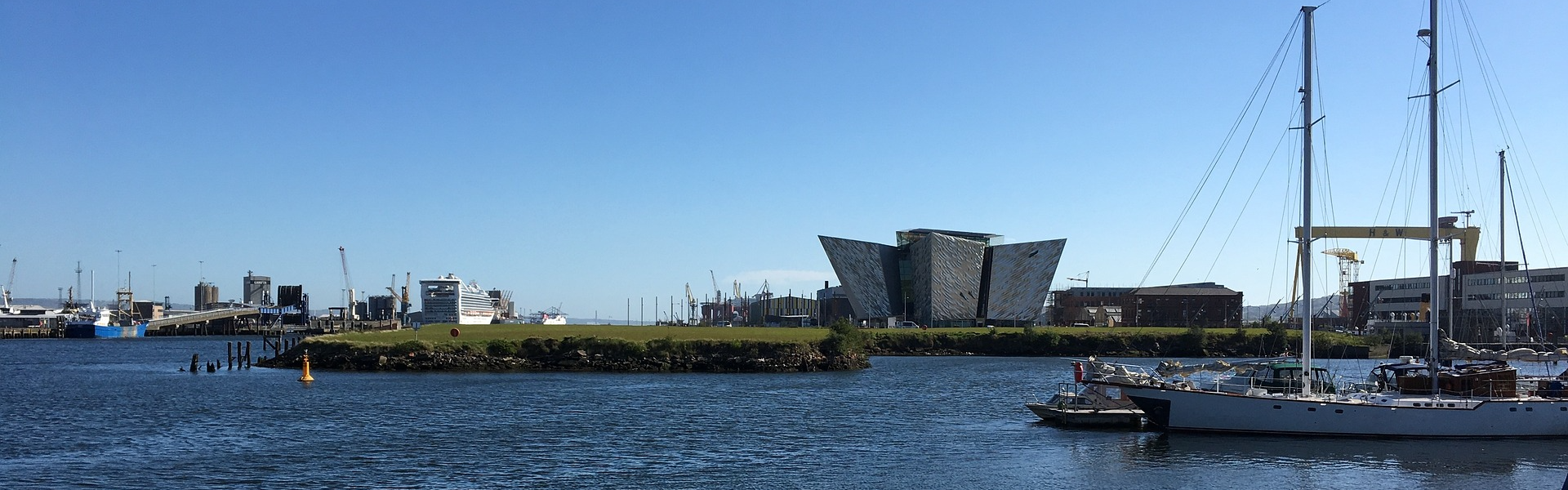
Belfast tells the story of the twentieth century like few cities in Europe. The Harland and Wolff shipyard, whose yellow cranes Samson and Goliath still dominate the harbour, launched the Titanic in 1911; Titanic Belfast, opened in 2012 on the original slipways, recounts it all across six floors, from drawing board to sinking. Closer to our own time, the murals of Falls Road and Shankill Road, the peace walls and the stories told by black cab drivers immerse visitors in the history of the Troubles with rare frankness.

The city also rewards anyone who stays for dinner and a night out. The Cathedral Quarter lines its cobbled entries with colourful murals and music pubs like the Duke of York; the Victorian St George's Market, open Friday to Sunday, mixes fishmongers, record stalls and local food counters; and the Crown Liquor Saloon, a National Trust property, pours pints inside carved wooden snugs. All of it comes at prices noticeably gentler than Dublin's.

Belfast finally serves as the base for one of Europe's great coastal drives. The Antrim coast strings together the Giant's Causeway and its 40,000 basalt columns, a UNESCO World Heritage site since 1986, the Carrick-a-Rede rope bridge and the tree tunnel of the Dark Hedges. Many travellers fold the city into a wider loop through the Republic; our Ireland guide lays out the full itinerary.

When to go

PeriodClimate and atmosphereVerdict
December to February3 to 8 °C, short days, Christmas market outside City Hall in DecemberLow season, gentle prices; good for a city break
March to April7 to 12 °C, first fine days, St. Patrick's Day celebrated in the north tooGood period, coast still quiet
May to June11 to 17 °C, long days, Antrim coast calm before summerExcellent choice, the best of the year
July to August14 to 19 °C, peak season at the Giant's Causeway, festivals; July 12 parades close some businessesPleasant, but book early and hit coastal sites in the morning
September12 to 16 °C, thinning crowds, beautiful coastal lightExcellent choice for combining city and coast
October to November7 to 12 °C, more frequent rain, possible Atlantic stormsFine for the city, less so for the coast

How to get there from Canada

The most direct path runs through Dublin. Air Canada flies nonstop from Montréal in about 6 hours, while Air Canada, Aer Lingus, Air Transat and WestJet all fly nonstop from Toronto in 6.5 to 7 hours, with evening departures and morning arrivals. From Dublin Airport, direct coaches reach Belfast in about 2 hours with no changes; the Enterprise train also links central Dublin to Belfast in just over 2 hours. Travellers meet no routine checks at the border, but the UK ETA must be secured before leaving Canada.

The alternative runs through London: overnight flights from Montréal or Toronto to Heathrow with Air Canada, British Airways or WestJet, then a domestic hop of about 1 hour 20 minutes to Belfast City Airport, right in town. European connections also serve Belfast International, about 30 minutes from the centre. This routing skips the land transfer at the cost of a connection, and makes most sense when London already figures in your plans.

Belfast's neighbourhoods and must-sees

The Titanic Quarter

On the former grounds of the Harland and Wolff shipyard, Titanic Belfast stacks six interactive floors above the slipways where the liner took shape between 1909 and 1912. The ticket also covers the SS Nomadic, the last White Star Line vessel afloat, which ferried passengers out to the ship at Cherbourg. Book a timed slot online, especially in summer.

The city centre and City Hall

The 1906 City Hall, all copper dome and Italian marble, offers free weekday tours, and its lawns host the Christmas market in December. Steps away, the Crown Liquor Saloon serves Guinness amid Victorian tilework and carved snugs, while St George's Market has animated weekends since the 1890s.

The Cathedral Quarter

Around St Anne's Cathedral, nineteenth-century warehouses now house the city's liveliest nightlife. The Duke of York's mirror-lined alley, the murals of Hill Street and a steady diet of live music make this the quarter for ending the evening. Arts festivals roll through in spring and autumn.

West Belfast and the peace walls

Falls Road, Catholic and republican, and Shankill Road, Protestant and loyalist, keep their political murals and the peace walls that still separate them, with some gates closing at night even now. A black cab tour, led by drivers who grew up during the Troubles, remains the best way into this history; allow about 90 minutes and book a day ahead.

The Queen's Quarter

South of the centre, Queen's University, founded in 1849, sets the district's student tone: cafés, bookshops and the Botanic Gardens with their Victorian palm house. The free Ulster Museum ranges from an Egyptian mummy to Spanish Armada treasure and an unflinching gallery on the Troubles. The area also gathers some of the city's best dinner tables.

The Antrim coast as a day trip

About 90 minutes up the road, the Giant's Causeway spreads its hexagonal basalt columns, formed by volcanic activity some 60 million years ago and listed by UNESCO since 1986. A classic day adds the Carrick-a-Rede rope bridge, strung 30 m above the sea, the Dark Hedges and a stop at Bushmills, the world's oldest licensed distillery (1608). Go by rental car or organized tour from Belfast.

The budget, in Canadian dollars

ItemBudgetComfortHigh end
Round-trip flight from Canada$750 to $1,050 (via Dublin)$1,000 to $1,500$2,500 and up (business class)
Accommodation (per night, 2 people)$100 to $150$170 to $260$320 and up
Meals (per day, per person)$35 to $55$60 to $100$140 and up
Local transport (per day)$5 to $15 (bus, walking)$40 to $80 (rental car, fuel)$130 and up (private tours)
Activities and sightseeing (per day)$0 to $20 (free museums)$35 to $65$110 and up

These ranges are provided as a guideline, based on rates and prices observed in 2025-2026. They vary with the season, the exchange rate and how far ahead you book. Belfast remains noticeably cheaper than Dublin for hotels and dining, a solid argument for giving it two or three nights within an Irish itinerary.

Entry requirements and health for Canadian citizens

  • UK ETA: required for Canadians before entering the United Kingdom, including Northern Ireland. It costs about 20 pounds (around 37 Canadian dollars), is applied for online, stays valid 2 years with multiple entries and allows stays up to 6 months. Strictly enforced since February 25, 2026.
  • Land border: no routine checks between the Republic and Northern Ireland, but the ETA remains legally required, even arriving by train or coach from Dublin.
  • Passport: valid for at least the expected duration of your stay; travel on the passport used for your ETA application.
  • Official advisory: the Government of Canada advises a high degree of caution in the United Kingdom due to the threat of terrorism, an advisory covering the whole country.
  • EES and ETIAS: neither applies in the United Kingdom or Ireland, both outside the Schengen area; still check travel.gc.ca before departure if continental Europe is part of your route.
  • Health: keep routine vaccinations current; travel.gc.ca also suggests hepatitis B. Nothing is required for entry.
  • Travel insurance: strongly recommended; non-residents pay for care and provincial plans cover only part of costs abroad.
  • Money: banknotes issued by Northern Irish banks are sometimes refused in Great Britain; spend them locally. Cards are accepted almost everywhere.

One last tip: two or three nights cover Belfast and the Antrim coast. The most natural plan folds the city into a ten-day Irish loop starting in Dublin, UK ETA secured and a few pounds sterling in your wallet.

Ready to stand on the columns of the Giant's Causeway after a night out in the Cathedral Quarter? The advisors at Voyages AquaTerra build your custom itinerary. 450-628-6241 | 1-866-628-6241 | info@voyagesaquaterra.com

Voyages AquaTerra is a licensed travel agency in Québec.

Frequently Asked Questions

Belfast is part of the United Kingdom, so Canadians must obtain a UK Electronic Travel Authorisation (ETA) before travelling. It costs about 20 pounds, is applied for online, stays valid for 2 years and allows stays of up to 6 months. The requirement has been strictly enforced since February 25, 2026.
There are no nonstop flights between Canada and Belfast. The simplest route is the nonstop to Dublin, about 6 hours from Montréal or 6.5 to 7 hours from Toronto, followed by a 2-hour train or coach ride north. You can also connect through London, with a 1 hour 20 minute domestic flight to Belfast. Allow 9 to 12 hours door to door.
May through September, with temperatures of 14 to 19 °C and long days for the Antrim coast. May, June and September dodge the summer crowds at the Giant's Causeway. Winter stays mild but damp, with short days.
The Government of Canada advises a high degree of caution in the United Kingdom due to the threat of terrorism, an advisory that covers the whole country. Belfast's tourist districts are visited without particular concern; the Troubles ended with the 1998 Good Friday Agreement, and the formerly divided neighbourhoods are now explored on guided tours.
As a guideline, plan on 2,200 to 3,600 Canadian dollars per person for a week, flight included, at a mid-range level. Belfast costs noticeably less than Dublin for hotels and meals, which makes it an economical base for Northern Ireland.
Belfast runs 5 hours ahead of Montréal and Toronto for most of the year. The gap briefly drops to 4 hours for about a week in late March and late October, since Europe and North America change their clocks on different dates.
Yes. The land border between the Republic of Ireland and Northern Ireland has no routine checks, but the ETA is still legally required to enter the United Kingdom, even by coach or train. Apply online before leaving Canada to travel with peace of mind.
The pound sterling; 1 pound is worth about 1.90 Canadian dollars. Note the switch if you arrive from the Republic: euros are not accepted in Belfast. Northern Irish banks issue their own banknotes, fine locally but sometimes refused in Great Britain, so spend them before moving on. Cards cover almost everything.
Yes, easily. The site lies about 90 minutes north of the city by road. Organized day tours typically combine the Giant's Causeway, the Carrick-a-Rede rope bridge and the Antrim coastal route, often with a stop at Bushmills, licensed to distill since 1608.
Yes, it is the city's flagship attraction. Opened in 2012 on the slipways of the Harland and Wolff shipyard, where the liner was built between 1909 and 1912, the museum tells the story across six floors, from design to sinking. Book a timed ticket online, especially in summer, and leave time for the SS Nomadic moored alongside.
  • #Travel
  • #Tourism
  • #Belfast
  • #Ireland
  • #Visit
  • #Attractions
  • #Culture
  • #Food
  • #Hotels
  • #Business Travel
  • #Expat
  • #Irish Community
  • #Activities
  • #Events
  • #Embassy
  • #Visa
  • #Language
  • #International Schools
  • #Experience
  • #Atmosphere
  • #Irish Residents
  • #Guide
  • #Information
  • #Tips
  • #Stay
  • #Traditions
  • #Irish Festivals
  • #Irish Diaspora
  • #Diplomatic Relations
  • #Trade
  • #Investment.