Departure

Return


Loading

Zagreb Travel from Canada: The Complete Guide

Zagreb is the easiest Croatian city to reach from Canada: Air Transat flies nonstop from Toronto in summer, about 8 hours 45 minutes twice a week, currently the only direct link between the two countries. From Montréal, or outside the summer season, one stop through Toronto, Munich, Frankfurt or Vienna brings the total trip to roughly 9 to 12 hours. Canadian citizens do not need a visa for stays of 90 days or less in the Schengen area. The Croatian capital feels Central European, shaped by its Habsburg past: a medieval upper town, Austro-Hungarian avenues and cafés that fill at every hour. May, June and September bring the finest days, while December transforms the centre with Advent, the city's signature holiday season. As a guideline, plan on $2,200 to $3,500 CAD per person for a week, flight included.

The essentials at a glance

QuestionAnswer
Flight from CanadaSeasonal nonstop from Toronto with Air Transat (about 8 h 45); one stop from Montréal or year-round via European hubs, 9 to 12 hours total
Visa for CanadiansNone for stays of 90 days or less in any 180-day period (Schengen area)
Time difference6 hours ahead of Montréal and Toronto (5 hours for a few weeks around clock changes)
CurrencyEuro (€); 1 € is worth about $1.60 CAD
LanguageCroatian; English is widely spoken, especially by people under 40
Best time to goMay to June and September; December for Advent
DrivingCanadian licence accepted, international driving permit recommended; winter tires mandatory November 15 to April 15
Electricity230 V, type C and F plugs; adapter required

Why Zagreb

Most travellers rush through Zagreb between the airport and the coast; that is a scheduling mistake. The capital has a two-level historic core: above, Gornji Grad with its gas-lit lanes, St. Mark's Church and its roof of glazed tiles bearing coats of arms, and the Stone Gate, a shrine set inside a medieval archway; below, the squares and avenues of the 19th century, laid out on the Viennese model. A 66-metre funicular, among the shortest in the world, links the two levels in under a minute.

The city is lived first in its cafés and markets. On Saturday mornings, the špica, a social ritual of settling in downtown to see and be seen, fills the terraces of Tkalčićeva street and the area around Jelačić Square. Steps away, the Dolac market spreads its red parasols over farm stalls. As for museums, Zagreb takes chances: the Museum of Broken Relationships, devoted to objects left over from failed love stories, has become its most distinctive attraction, and the Nikola Tesla Technical Museum delights families with live demonstrations.

The closing argument comes down to wallet and geography. Meals, museums and hotels cost less than in almost any other European capital, and far less than the Croatian coast in summer. The city also radiates outward: Plitvice Lakes are a 2-hour drive, the baroque town of Samobor 30 minutes, the Zagorje castles under an hour. In winter, Advent, voted best Christmas market in Europe three years running (2016 to 2018), gives the capital its signature season.

When to go

PeriodClimate and vibeVerdict
DecemberCold (around 0 °C), Advent on the squares, ice rink and mulled wineFor the holiday atmosphere
January to MarchContinental cold, possible snow, museums and warm cafésLow prices, a city left to its residents
April and May12 to 21 °C, parks in bloom, terraces filling upLovely window
June22 to 27 °C, open-air festivals, long eveningsPrime time
July and August26 to 30 °C, occasional storms, many locals gone to the coastPleasant and calm, affordable hotels
September and October15 to 25 °C, autumn light, grape harvest in the ZagorjeReliable choice
NovemberGrey and cool, quiet city before AdventFor tight budgets

How to get there from Canada

In summer, the most direct option leaves from Toronto: Air Transat links YYZ and Franjo Tuđman Airport twice a week, nonstop, in about 8 hours 45 minutes, with easy connections from Montréal. It is currently the only nonstop route between Canada and Croatia. The rest of the year, count on one European stop from either city: Lufthansa via Munich or Frankfurt, Austrian Airlines via Vienna or Air France via Paris, for a total trip of 9 to 12 hours.

The airport sits about 15 km from the centre; the shuttle bus reaches the main bus station in roughly 30 minutes, and taxis cost a fraction of what they do in neighbouring capitals. Zagreb also makes an excellent gateway for a road trip: the motorway reaches Split in about 4 hours, with Plitvice roughly halfway. To plan the full route, see our Croatia guide.

Zagreb's neighbourhoods and highlights

Gornji Grad, the upper town

The medieval quarter takes half a day: St. Mark's Church with its glazed-tile roof displaying the arms of Croatia and Zagreb, the Lotrščak Tower, where a cannon shot has marked noon since 1877, and the Stone Gate, where locals pause to light a candle. Ride the funicular up and walk back down Radićeva street to feel the city's change in elevation.

Dolac and Jelačić Square

The central square, watched over by the equestrian statue of Ban Jelačić, is the city's universal meeting point. Just behind it, the Dolac market runs every morning until about 2 p.m.: fresh Zagorje cheeses, honey, flowers and, on the lower level, Adriatic fish. Try štrukli, the region's signature cheese pastry, at one of the nearby addresses.

Tkalčićeva and café life

This former street of watermills, now the city's terrace row, lines up cafés, craft breweries and restaurants for several hundred metres. The local rule: coffee is taken slowly, often with nothing to eat, and nobody will hurry you off the table. On Saturday mornings, špica hour makes it the best people-watching spot in town.

Donji Grad and the green horseshoe

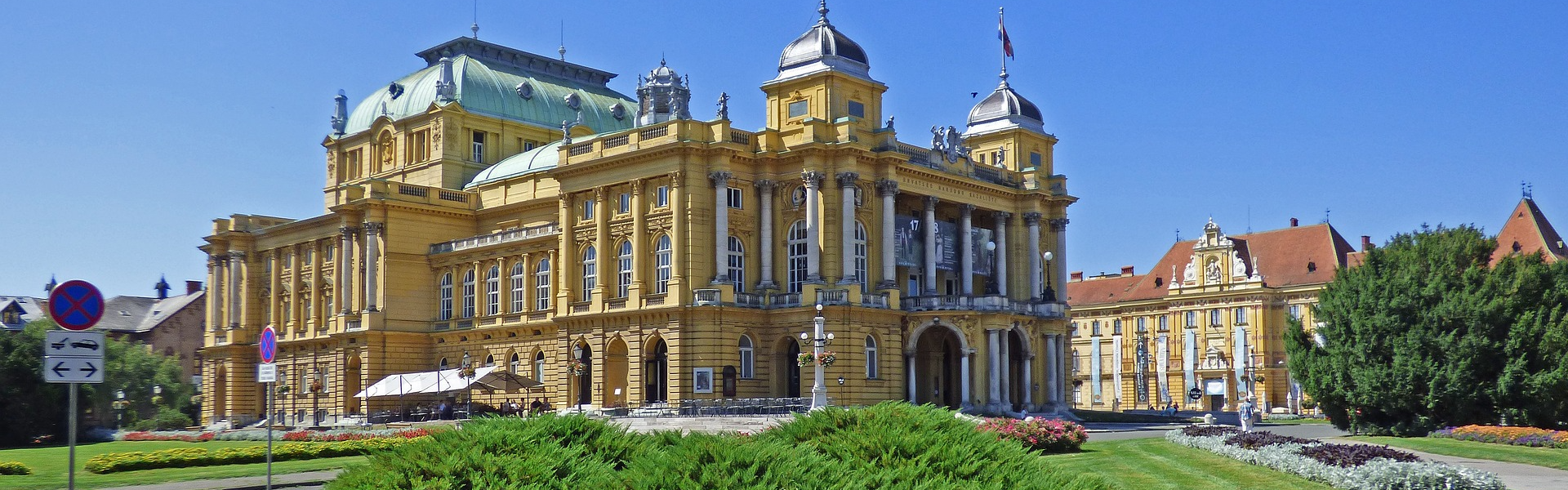
The 19th-century lower town is organized around Lenuci's horseshoe, a sequence of garden squares linking the train station to the centre: the Art Pavilion, the national theatre, the botanical garden. The Museum of Broken Relationships up the hill and the Mimara Museum round out a dense cultural circuit, with entry fees that rarely top $15 CAD.

Mirogoj and Maksimir

North of the centre, Mirogoj cemetery, designed by architect Hermann Bollé, lines up ivy-covered neo-Renaissance arcades considered among the finest funerary architecture in Europe; bus 106 runs there from the cathedral. To the east, Maksimir Park, opened in 1794, offers lakes, trails and a small zoo, all reachable by tram.

Day trips

Plitvice Lakes, a 2-hour drive, string together 16 terraced lakes joined by waterfalls; book entry online in summer. Samobor, 30 minutes away, is worth the trip for its baroque centre and kremšnita, a custard slice served still warm. The Zagorje lines up castles and vineyards under an hour from town. From there, the road runs naturally down to Split and the Dalmatian coast.

The budget, in Canadian dollars

ExpenseBudgetComfortHigh-end
Round-trip flight from Montréal or Toronto$900 to $1,250$1,250 to $1,600$1,600 and up
Accommodation (per night, 2 people)$100 to $150$160 to $260$280 to $500
Meals (per day, per person)$35 to $55$60 to $100$110 to $200
Local transport (per day)$3 to $8$8 to $20$25 to $50
Activities and sightseeing (per day)$10 to $25$30 to $60$70 to $150

These ranges are provided as a guideline, based on exchange rates and prices observed in 2025-2026. Zagreb remains one of Europe's most affordable capitals: a short tram ride costs about $1 CAD and a full restaurant meal often comes in under $30 CAD per person.

Entry requirements and health for Canadian citizens

  • Visa: none required for stays of 90 days or less in any 180-day period in the Schengen area.
  • Passport: valid for at least 3 months beyond your planned date of departure from the Schengen area; a larger margin is wise.
  • EES: since October 2025, the European Entry/Exit System records your photo and fingerprints at first entry; allow a few extra minutes at border control.
  • ETIAS: this travel authorization is not yet in force; launch is expected in late 2026. Check travel.gc.ca before you leave.
  • Official advisory: the Government of Canada advises taking normal security precautions in Croatia, its lowest level; pickpocketing is uncommon but possible on crowded trams.
  • Health: keep routine vaccinations up to date and consider hepatitis A; tick-borne encephalitis occurs in forested areas from April to November, relevant for Plitvice, Maksimir and the Zagorje.
  • Travel insurance: provincial health plans cover very little abroad; insurance for medical care, evacuation and cancellation is strongly recommended.
  • Winter driving: winter tires are mandatory from November 15 to April 15, and right turns on red lights are prohibited throughout Croatia.

One last tip: two to three nights cover the city, four with Plitvice and Samobor added. Zagreb fits best at the start or end of a Croatian circuit, paired with Split and the coast, or with Vienna and Budapest for a Central European loop.

Tempted by Advent mulled wine or a slow coffee on Tkalčićeva? The advisors at Voyages AquaTerra build your custom itinerary. 450-628-6241 | 1-866-628-6241 | info@voyagesaquaterra.com

Voyages AquaTerra est titulaire d'un permis du Québec.

Frequently Asked Questions

No visa is required for Canadian citizens staying 90 days or less in any 180-day period, since Croatia belongs to the Schengen area. Since October 2025, the EES system records your photo and fingerprints at first entry. ETIAS, expected in late 2026, is not yet in force; check travel.gc.ca before departure.
In summer, Air Transat flies nonstop from Toronto in about 8 hours 45 minutes. From Montréal, or outside the summer season, plan on 9 to 12 hours total with one stop, via Toronto or a European hub such as Munich, Frankfurt or Vienna.
May, June and September bring 20 to 27 °C, full terraces and green parks. December has its own appeal with Advent, the city's signature holiday season. July and August stay pleasant, though many locals head for the coast.
Yes. The Government of Canada advises taking normal security precautions in Croatia, its lowest advisory level. Zagreb ranks among Europe's calmer capitals; standard caution against pickpockets on trams and at markets is enough.
As a guideline, plan on $2,200 to $3,500 CAD per person for a week, flight included. The Croatian capital remains one of Europe's most affordable major cities: a full restaurant meal often costs under $30 CAD.
Zagreb runs 6 hours ahead of Montréal and Toronto for most of the year. The gap briefly narrows to 5 hours for a few weeks in March and about a week each fall, since Europe and North America change their clocks on different dates.
Yes, seasonally: Air Transat connects Toronto and Zagreb nonstop twice a week in summer, in about 8 hours 45 minutes. It is currently the only nonstop link between Canada and Croatia; the rest of the year, you connect through a European hub.
It is the capital's holiday market, spread across downtown squares and parks from late November to early January: stalls, an ice rink, concerts and mulled wine. The event was voted best Christmas market in Europe three years running, from 2016 to 2018.
Yes, easily. The national park lies about 130 km south, a 2-hour drive or coach ride, making it the most popular day trip from the capital. Book your entry ticket online in summer and leave early to stay ahead of the tour groups.
Two to three days cover the upper town, the museums and the café scene at a relaxed pace. Add a day for Plitvice and a half-day for Samobor or the Zagorje castles, and Zagreb becomes the natural starting point for a one- or two-week Croatian circuit.
  • #Sightseeing
  • #travel
  • #tourism
  • #culture
  • #history
  • #architecture
  • #museums
  • #restaurants
  • #nightlife
  • #churches
  • #cathedrals
  • #markets
  • #parks
  • #events
  • #festivals
  • #gastronomy
  • #cafes
  • #shopping
  • #art
  • #galleries
  • #excursions
  • #transportation
  • #airport
  • #rentals
  • #hotels
  • #accommodation
  • #routes
  • #nature
  • #hiking
  • #mountains.