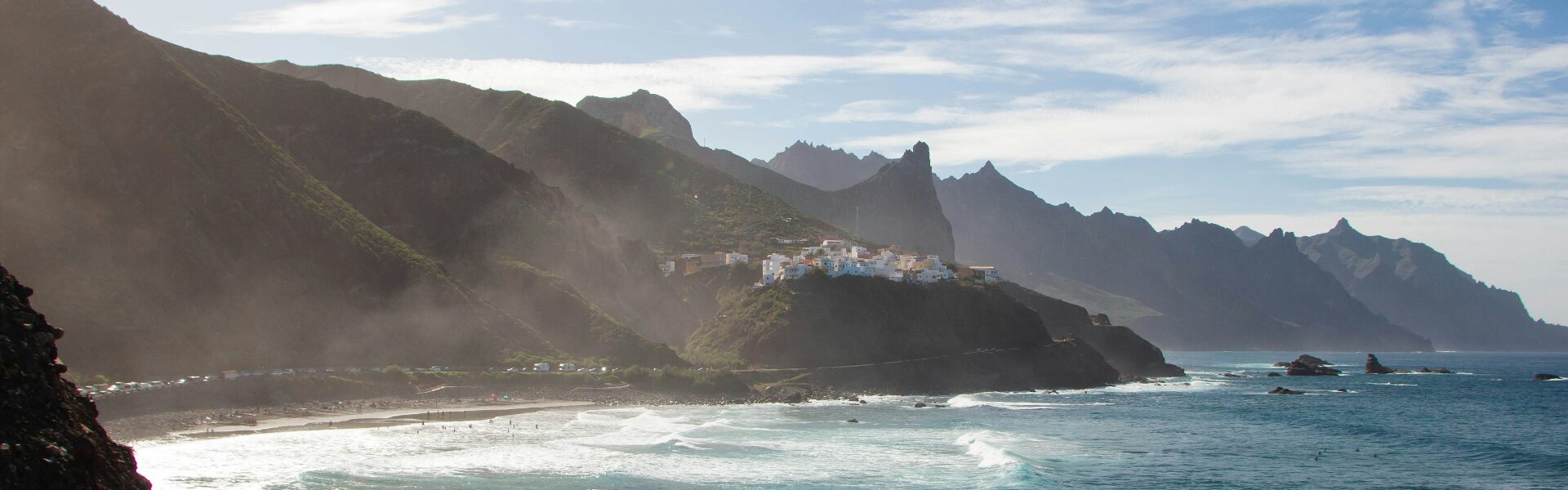
Tenerife travel from Quebec: the essentials
Air Canada has flown Montreal to Tenerife South nonstop since 31 October 2026, one departure a week on Saturday evening, seven hours in the air. It is the only direct link between North America and the Canary Islands, and it runs through 24 April 2027.
Tenerife is the largest of the seven Canary Islands, off the south of Morocco, in Spanish territory. A 3,715-metre volcano splits it in two and gives it two climates on an island you can cross in ninety minutes.
Why Tenerife
For a Quebec traveller used to the Caribbean, the case rests on four points.
The island sits outside the hurricane corridor. The tropical Atlantic pushes its storms west, and the Canaries get one a decade rather than one a season. Tropical Storm Delta in 2005 and Storm Hermine in 2022 remain the two exceptions people still talk about there.
This is Europe. Hospitals, motorways, tap water, pharmacies, cell coverage, restaurants open to everyone. A long winter stay here feels like living in a town rather than inside a fenced resort.
The terrain changes the day. Breakfast by the sea, then an afternoon walk through pine forest at 2,000 metres. Teide National Park has been a UNESCO World Heritage site since 2007.
The sea stays swimmable, but cool. Between 19 and 22 degrees depending on the month, at its lowest in February and March. That is six or seven degrees below Punta Cana, and you should know it before you pack.
When to go to Tenerife
The direct-flight season covers exactly the months Quebec needs it, late October through late April.
| Coast | Day | Night | Rain | Feel |
|---|
| South (Costa Adeje, Los Cristianos) | 19 to 22 °C | 15 to 18 °C | Rare from January to April | Dry, sunny, near-desert |
| North (Puerto de la Cruz) | 17 to 19 °C | 10 to 13 °C | Wetter in November and December | Green, cloudier, cultivated |
The sea runs near 22 degrees in November and drops toward 19 in February and March, on both sides of the island.
The south stays dry because the trade winds hit the volcano and drop their moisture on the north side. Locals call that low cloud cover the panza de burro, the donkey's belly. It often lifts by mid-afternoon.
Two phenomena deserve a mention. The calima, a dust wind out of the Sahara, reaches the archipelago on roughly 146 days a year by local counts: the sky turns milky, the air dries out, and it passes in two or three days. The Santa Cruz carnival, one of the largest in the world, runs from 19 to 28 February 2027, with the opening gala on 22 January.
Getting there from Montreal
| Flight | Day | Departs | Arrives | 2026-2027 season |
|---|
| AC956 Montreal to Tenerife South | Saturday | 21:00 | 09:00 next day | 31 October to 24 April |
| AC957 Tenerife South to Montreal | Sunday | 10:55 | 14:10 | 1 November to 25 April |
The aircraft is an Airbus A321XLR with two cabins only: 14 lie-flat seats in Signature Class and 168 in economy. Premium Economy does not exist on this aircraft, which surprises travellers used to the 787. Toronto gets two departures a week, Thursday and Sunday, on AC954 and AC955.
The time difference deserves a note. The Canaries run on United Kingdom time rather than Madrid time, which puts five hours between Montreal and Tenerife in midwinter. Since Europe sets its clocks back on 25 October and Canada on 1 November, the gap drops to four hours during that one week.
The airport served is Tenerife South (TFS), at the bottom of the island. Tenerife North (TFN), near La Laguna, handles mostly domestic and inter-island flights.
North or south, you have to choose
The two coasts of Tenerife offer different holidays. Here is how they compare, with drive times from TFS airport.
- Costa Adeje, about fifteen minutes. Four- and five-star hotels, a seafront promenade, groomed beaches, careful restaurants. The pick for couples and families who want comfort without hunting for it.
- Los Cristianos, about twenty minutes. A real small town with its market, its harbour and its ferries to La Gomera and La Palma. Livelier and less polished than its neighbour.
- Playa de las Américas, adjoining both. Nightlife, bars, young Europeans. Avoid it if you want quiet, aim for it if you want atmosphere.
- Puerto de la Cruz, on the north coast, about an hour's drive. Historic town, botanical garden, sea pools designed by César Manrique, banana plantations. Cooler, cloudier, far greener. Europeans have wintered here for a century.
- Santa Cruz and La Laguna, about forty minutes. The capital and its university neighbour, whose old town has been UNESCO-listed since 1999. A city stay rather than a beach stay.
The Air Canada Vacations long-stay package settles the question by splitting it: seven nights north in Puerto de la Cruz, fourteen nights south in Costa Adeje, with a private transfer between them. Twenty-three days in all, from November 2026 to April 2027.
Half board, and why this is not a Caribbean all-inclusive
Here is the point that causes the most confusion, and it is worth stopping on.
In the Canaries the common formula is half board: breakfast and dinner, served at the hotel buffet. Lunch and drinks are on you. The Air Canada Vacations long-stay package follows that rule exactly, with 21 breakfasts and 21 dinners over 21 nights.
All-inclusive does exist in Tenerife, mostly in the southern resorts, though it has never been the norm the way it is in the Dominican Republic or Mexico. A client who reads the word "package" and pictures an open bar and a three o'clock snack will be disappointed by their second lunch.
This is a different way to travel rather than a shortcoming. You eat in the villages, you walk into a guachinche, one of those winegrower's canteens in the hills, you pay for your grilled fish in Los Abrigos and you head back to the hotel for dinner. Over three weeks, plenty of people prefer that freedom to a wristband.
Have your advisor confirm your hotel's exact meal plan before you book. On a long stay, that one line changes the daily budget.
Mount Teide, and the permit to request in advance
Teide reaches 3,715 metres, making it the highest summit in Spain and the third-largest volcano in the world measured from its ocean base. The cable car climbs to La Rambleta station at 3,555 metres.
To cover the last stretch to the crater you need a free, named permit, booked on the Canary Islands government's official platform. Slots run two hours: 9 to 11, 11 to 13, 13 to 15 and 15 to 17. Book two to three months ahead, because high-season slots go quickly.
The cable car ticket is paid separately and the permit does not include it. Bear in mind that at 3,700 metres the air holds about a third less oxygen than at sea level, which you feel within the first few steps.
In winter, snow regularly closes the TF-21 and TF-24 roads up to the park, sometimes for a full day. It is the Canarian version of a February storm, and photographers love it: snow in the foreground, ocean behind.
What to do beyond the beach
- The Anaga massif, a biosphere reserve in the northeast, with laurel forest in the mist and trails cut along the ridge.
- Masca, a hamlet wedged in a ravine, and the road to it, one of the most spectacular in Spain.
- Garachico and the natural pools of El Caletón, carved by a lava flow in 1706.
- La Orotava, a historic centre of wooden-balconied houses and terraced gardens.
- Whale and dolphin watching. The channel between Tenerife and La Gomera holds resident short-finned pilot whales and bottlenose dolphins year round, and the area carries Whale Heritage Area status from the World Cetacean Alliance.
- The ferries. Los Cristianos reaches San Sebastián de La Gomera in about fifty minutes, up to five times a day, and Santa Cruz de La Palma in two and a half hours. A neighbouring island is a day trip.
Entry rules and health for Canadian citizens
A Canadian passport is enough, with no visa, for a tourist stay of 90 days in any 180-day period in the Schengen area. The passport must stay valid at least three months beyond your planned exit date.
Since 10 April 2026 the European Entry/Exit System has been fully operational. At your first Schengen border crossing they take a photograph and your fingerprints, which lengthens the arrival check. ETIAS still has no confirmed launch date, so avoid building a trip around its calendar.
The Government of Canada rates the Canary Islands at "take normal security precautions", one level below mainland Spain. Read the current advisory on travel.gc.ca before you leave, because these ratings change without notice.
Travel insurance is not required at the border, and it remains essential. Private clinics often ask for payment on the spot, and a medical repatriation from an Atlantic archipelago is expensive. Quebec's public plan reimburses a tiny fraction of care received abroad.
A word on long stays. Three weeks sits well under the Schengen limit. A three-month winter stay lands right at the 90-day line, and the count runs on a rolling 180-day window that includes every other European stay you made. Count your days, or have your advisor count them.
What can disappoint, and is better known in advance
- The sand is black. This is a volcanic island. The pale beaches of the south were engineered, and the wide golden beach of Las Teresitas near Santa Cruz was built with sand imported from the Sahara in 1973.
- The TF-1 motorway jams. A single artery serves the south, and one accident is enough to block the airport road. Leave early on departure day.
- The calima dries the air and veils the sky several days a month, mostly from January to March.
- Mass tourism is contested. Large demonstrations took place across the Canaries in 2024 and 2025 calling for a moratorium on new hotels. Visitors feel none of it, and it remains a local reality worth respecting.
- No general tourist tax applies in Tenerife today, though the legal framework that would let a municipality create one dates from July 2026. Worth watching.
Book with an advisor
A brand-new destination, a single weekly flight and a meal plan that differs from the Caribbean: three good reasons to go through someone who does this for a living. Our advisors confirm the hotel's exact meal plan, keep flight and hotel on one file, and stay reachable if the trip goes sideways.
Call us at 1-866-628-6241 or find an advisor near you. Voyages AquaTerra, Quebec licence 702703.