The last ship of her class, born in a difficult year
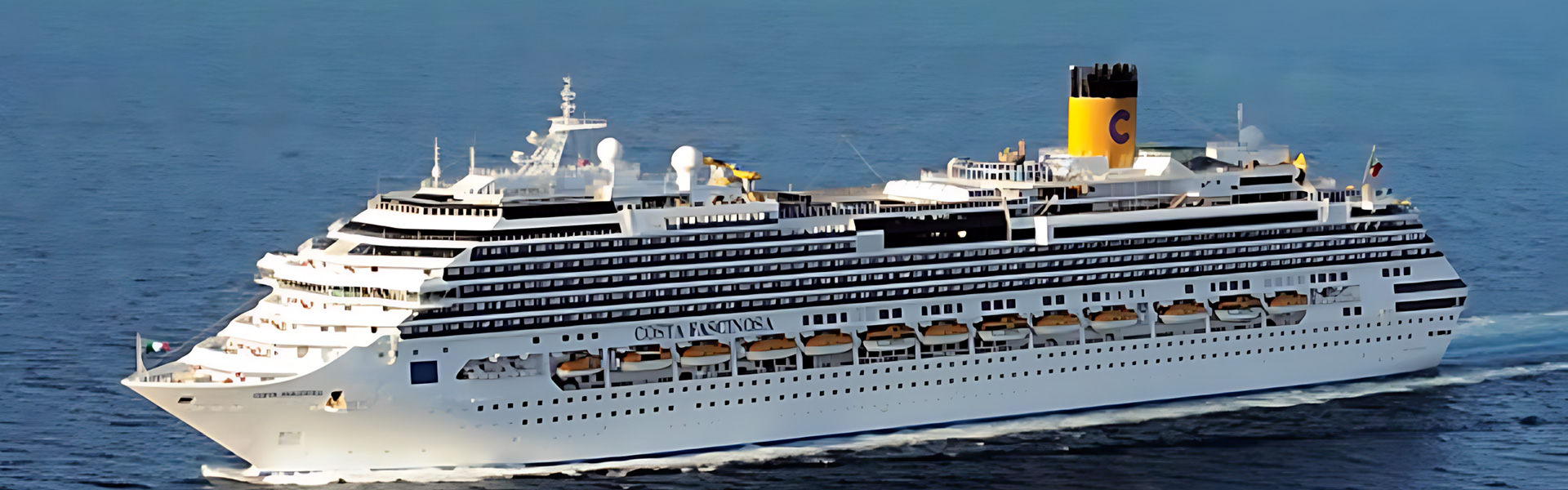
The Costa Fascinosa entered service on 6 May 2012. 289 metres, 1507 cabins,
3014 travellers at double occupancy. She is the last of the four ships of this
class to be built, and she was delivered four months after the wreck of the
Costa Concordia. She was the line's flagship until the Diadema arrived in late
2014.
We say it soberly because it is a fact of the calendar, not a judgement on
the ship. The hull is that of her three sisters and the refit dates from
2018.
Two seasons, two seas
Summer runs in the Mediterranean, first on short four-night cruises in the
west, then on seven nights eastward, with Catania, Taranto, Piraeus, Argostoli,
Valletta and Mykonos.
Winter brings the ship to the Caribbean, on seven nights out of the
Dominican Republic and Martinique. The proportion of North Americans aboard
rises markedly there, which changes the atmosphere.
The other ships in the fleet
The Costa Favolosa and the Costa Serena share her hull exactly. The Costa Toscana is a liquefied natural gas
ship. The Costa Deliziosa has the best ratio of cabins with a balcony.
A fleet halved in six years
Costa operated sixteen ships in 2019. It operates eight since mid-September
2026. That is not a slowdown, it is a contraction: seven hulls were sold or
transferred to other brands, one was scrapped in Turkey, and the latest
departure dates from this month.
The house is Genoese and old. Founded in 1854 in olive oil and textiles, it
moved to shipping in 1924 and to carrying passengers in 1947. An American
group bought half of it in 1997 and all of it in 2000. It has since belonged to
a set of nine cruise brands, where its position has clearly weakened: three of
its ships were transferred to the group's more profitable North American
brand.
A word about 13 January 2012, because there is no reason to skirt it. The
Costa Concordia struck rocks off the island of Giglio with 4252 people aboard.
The toll: 33 dead, including a diver killed during the salvage. The captain was
sentenced to sixteen years. The whole industry drew from it the muster drill
now compulsory before sailing.
What the fare covers, and the item that surprises
Included: the sea passage, the cabin, meals in the main restaurants and the
buffet, evening shows, daily activities, the children's club and port taxes.
Cabin service is in the fare depending on the rate chosen.
Here is the item that surprises. A hotel service charge is added to your
onboard account every day. The North American contract calls it mandatory, it
is debited automatically, and the sums are pooled and shared among the staff.
You may ask for it to be adjusted at the front desk during the cruise; once
ashore, it is final.
Not included: the flight, insurance, drinks outside meals, excursions,
speciality restaurants and treatments. The excursion catalogue is among the
largest in the business, and the item adds up fast on an itinerary with a call
every day.
Who this trip is for, and who it is not for
The clientele is European, often Italian: couples from thirty-five to
fifty-five, retirees, families in summer. On Caribbean and South American
itineraries the proportion of North Americans rises markedly. Costa ranks last
among the large lines in English-language traveller rankings.
Four things unsettle a Quebecer. Announcements run through several languages
in turn, which lengthens everything. The evening buffet opens on European
hours, sometimes not before half past seven. Tolerance of smoking is wider than
in North America, including on some balconies. And the daytime programme is
thin: most of the entertainment is concentrated after dinner.
On accessibility, the line publishes no official table of adapted cabins.
The circulating numbers come from third-party databases derived from deck
plans: indicative, never contractual. For a traveller in a wheelchair, the
cabin is validated with the line before the deposit.
From Quebec
The flight is not part of the cruise fare, and none of these routes begins
here. Depending on the embarkation port, expect a direct flight to Europe or a
connection; for the Caribbean and South America a connection is almost always
needed. Arrive the day before at the very least: a cruise ship leaves on
time.
A point of law better read before than after. The carrier is a company under
Italian law; the North American entity is only its sales agent. The contract of
passage provides for Italian law and the courts of Genoa, exclusively, and
invokes the Athens Convention, which caps liability for personal injury.
Nothing establishes that this line holds a Quebec travel agent's licence.
Your protection comes from elsewhere: Voyages AquaTerra holds a licence from
Quebec's Office de la protection du consommateur, and the Compensation Fund for
Customers of Travel Agents covers your file.