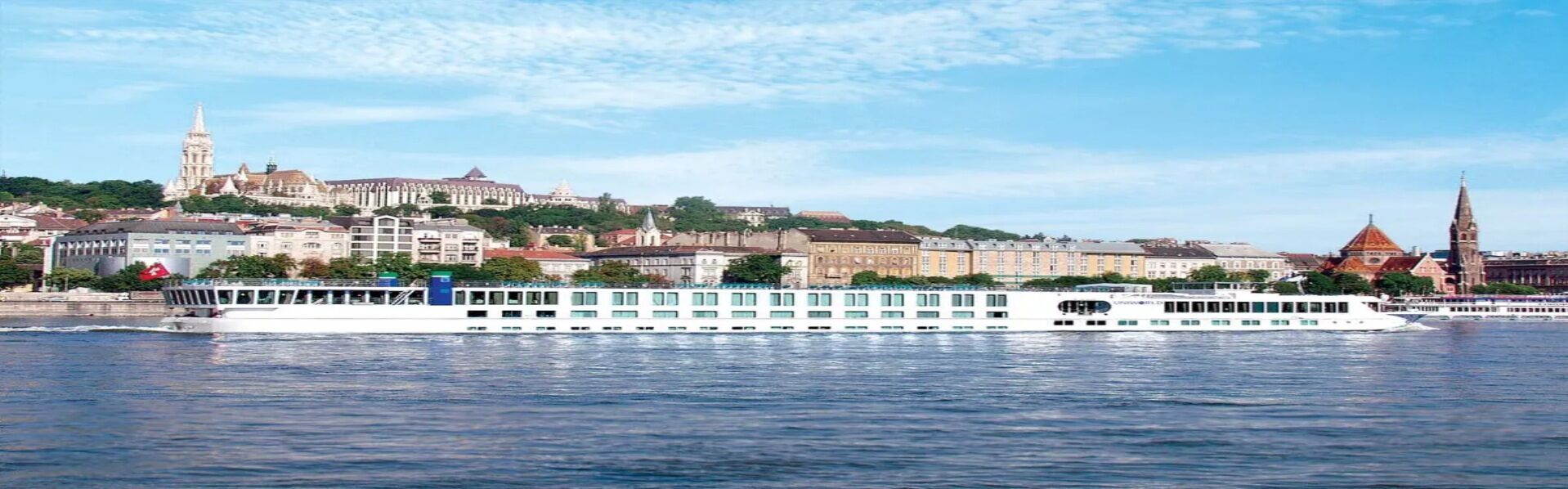
Became the Trafalgar Reverie in April 2026
The River Princess no longer sails under that name. In April 2026 the hull
moved to a sister brand within the same group and now carries the name
Trafalgar Reverie. She was named on 11 April 2026 at Passau,
on the Danube, where she still works.
The distinction matters. This is not a sale: the hull did not leave the
group, it changed marque inside it. Nor is it merely a change of name: the
product, the service and the commercial positioning are no longer the same. A
traveller who loved this hull under her former flag will not find quite the
same journey under the new one.
What changed aboard, and what did not
A light refresh went with the transfer: mattresses, carpets, taps, paint and
charging sockets. That is a refresh, not a rebuild. The hull, from the Den
Breejen yard at Hardinxveld-Giessendam in the Netherlands, dates from 2001 and
had a real rebuild in 2011. One hundred and ten metres, 66 cabins, 128
travellers.
The exact legal nature of the operation stays unclear. One source speaks of
a charter between sister brands, another of group ownership. Both are
compatible and neither is published as official. What we know for certain is
the name, the date and the river.
Booking the Danube today
The S.S. Beatrice covers the Danube, the Main and the Rhine. The S.S. Maria Theresa adds the Main. The
S.S. Emilie is the brand's fiftieth anniversary ship. The S.S. Marlene works the Danube on a more
recent hull.
Owned or chartered
Both, depending on the hull. This line owns part of its fleet and rents the
rest from shipowners who keep those vessels in their own catalogues. The sales
material does not draw the distinction, which is why some disappearances stay
unexplained.
A chartered ship can leave the programme overnight without being sold,
without being scrapped, without even changing name. It simply goes back to the
company that has always operated it.
The inclusions, unrounded
The fare covers onboard gratuities, drinks at meals and the excursions
listed in the itinerary. It also covers internet access, with no promise of
performance whatever: coverage varies enormously from one stretch of river to
the next.
It does not cover the air. Nor does it cover gratuities to coach drivers
during shore excursions, unlike those to the crew. And airport transfers are
included only provided the ticket comes from the line.
Reduced mobility: read this before booking
Able companion required. Folding wheelchair only. Mobility scooter refused.
Disembarkation possible mid-voyage, with no refund, if the crew judges the
traveller can no longer follow the programme.
The number of adapted cabins is published nowhere, on any ship, and the
site's accessibility statement covers only the site itself. Bathrooms are
fitted with grab bars, which does not make them accessible bathrooms. Your
advisor asks the questions case by case before confirming anything.
Three legal systems, none of them Quebec's
River transport is contracted under Swiss law, with venue at Rheinfelden;
the line's own documents name Rheinfelden in one place and Basel in another,
and that contradiction sits in its own conditions. On the Canadian side, it is
Ontario. On the American side, California.
No Quebec licence is established for this operator. It is the agency that
brings the protection from here: a licence from the Office de la protection du
consommateur, a trust account separate from the firm's own funds, and the
Compensation Fund for Customers of Travel Agents. Those three follow a booking
made here, and only that one.