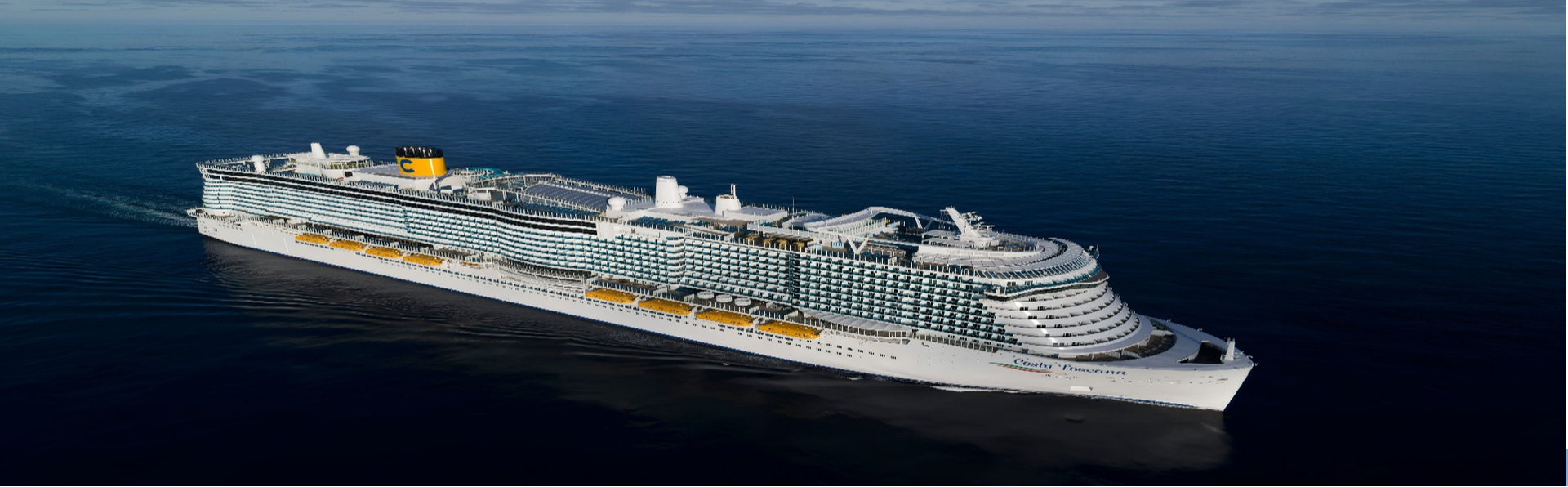
The ship that least resembles Costa
The Costa Toscana entered commercial service in March 2022. 337 metres,
2663 cabins, 5322 travellers at double occupancy, powered entirely by liquefied
natural gas. Interior architecture by two American practices, nineteen bars,
eleven restaurants and a three-level show lounge.
On paper she is the most accomplished ship in the fleet. In English-language
traveller rankings she is the lowest rated. That gap deserves explaining rather
than skirting.
Where the gap comes from
It does not come from the ship, it comes from the format. Announcements
running through several languages in turn, an evening buffet on European hours
and a thin daytime programme: a North American traveller comparing with the
lines of their own market finds the ship magnificent and the day empty.
A Europe-loving traveller, going ashore every day and back for dinner, never
meets that problem. Thirty adapted cabins are listed by a third-party database,
an indicative figure. The ship stays in the Mediterranean all year.
The other ships in the fleet
The Costa Smeralda is her exact twin. The Costa Pacifica and the Costa Fascinosa are older and have more inside
cabins. The Costa Diadema offers the largest number of adapted cabins.
The house, the group and the wreck
A Genoese house of 1854, come from olive oil and textiles, a shipowner since
1924, a carrier of passengers since 1947. An American group acquired half of it
in 1997 and all of it in 2000; it is one of nine cruise brands there.
The fact that matters today lies elsewhere: the fleet went from sixteen
ships in 2019 to eight in September 2026. Seven hulls sold or transferred, one
scrapped. That is half a company gone in six years, and it shows on our own
site, where nine pages out of seventeen describe a ship that is no longer
there.
On 13 January 2012 the Costa Concordia struck rocks off the island of
Giglio with 4252 people aboard. Thirty-three people died, including a diver
killed during the salvage. The captain was sentenced to sixteen years, upheld
on final appeal. We say it here because a client will read it elsewhere, and it
is better read accurately.
The fare in detail
Included are the cabin, board in the main restaurants and the buffet, shows,
activities, the children's club and port taxes. Excluded are the flight,
insurance, drinks outside meals, excursions, speciality restaurants, treatments
and laundry.
The hotel service charge is the item to explain before booking, not after.
It is added to your onboard account each day, the contract calls it mandatory,
and the sums are shared among the staff. It varies with age and with region.
You may ask for it to be adjusted at the front desk, but only while you are
aboard.
On drinks, a package exists and is bought in advance or aboard. Without one,
every drink goes on the account. The Italian coffee is excellent and it is
paid for, which often surprises a North American traveller used to free filter
coffee at the buffet.
Aboard, and for whom
Costa is excellent for a Europe-loving traveller who wants to be in Europe
the moment they board, who dines late, who goes ashore every day and who uses
the ship as a hotel. Costa suits badly a first-time cruiser comparing with the
big North American lines: they will be disappointed by the daytime programme
and unsettled by the multilingual announcements.
The concrete points. Announcements run through several languages in turn.
The evening buffet follows European hours. Smoking is tolerated more widely
than here. Service is more distant, less chatty. In exchange, the crew amounts
to roughly one person for every three travellers and the excursion catalogue is
among the largest in the business.
Accessibility, finally. No official table of adapted cabins is published
ship by ship. The circulating figures are derived from deck plans by
third-party databases: indicative, never contractual. A wheelchair booking is
validated with the line, cabin by cabin.
What this trip asks of you from Quebec
A flight not included in the fare, a hotel night before embarkation that we
recommend every time, and a valid passport. Door-to-door travel often exceeds
what the brochure suggests, especially when the embarkation port needs a
connection.
The recourse question comes up weekly with clients. The carrier is a company
under Italian law; the North American entity is only its sales agent. The
contract provides for Italian law, the courts of Genoa to the exclusion of all
others, and the Athens Convention, which caps liability for personal injury.
Quebec protection comes from the agency that sells. Nothing establishes a
Quebec licence in the line's name. Voyages AquaTerra holds a licence from
Quebec's Office de la protection du consommateur, deposits your payments in a
trust account, and your file falls under the Compensation Fund for Customers of
Travel Agents.