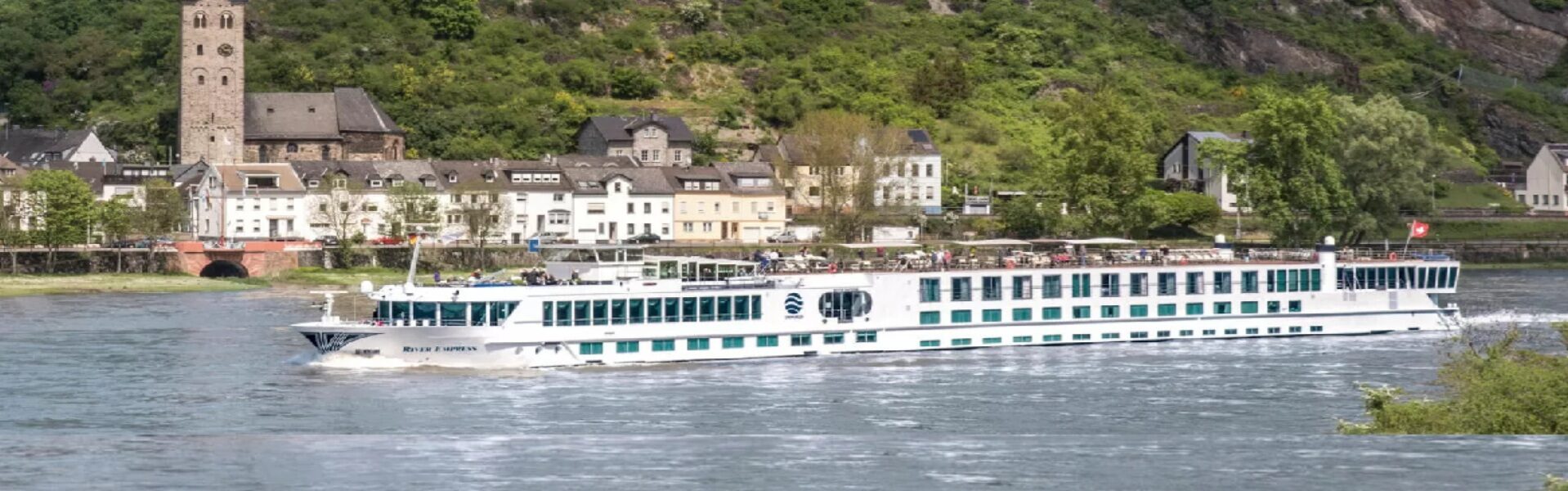
Became the Compass Empress
The River Empress has left this fleet. The hull was sold out of the group
and now carries the name Compass Empress: chartered to a
German company, she sails under the Dutch flag. She is the only ship in this
set to have left the group for good.
The date she left the fleet is published nowhere. No release, no catalogue
note, no sale announcement. The ship simply stopped appearing in the
programmes, and the hull had to be traced through her new name to find out
where she had gone.
The ship, as she was
One hundred and ten metres, 66 cabins, 132 travellers, out of the Den
Breejen yard at Hardinxveld-Giessendam in the Netherlands. The build year is
given as 2001 by one source and 2002 by another; the 2020 rebuild is
established. She worked the Rhine, the Main and the Danube, the three classic
axes of European river cruising.
A rebuild in 2020 and then an exit from the fleet a few years later: that is
a short cycle for an investment of this kind, and it shows how fast a river
fleet's make-up moves. A printed brochure runs two years behind.
Where to sail now
The S.S. Antoinette is the brand's large Rhine unit. The S.S. Beatrice covers the Danube, the Main
and the Rhine. The S.S. Maria Theresa adds the Main. The S.S. Victoria works the Rhine and the Mosel.
Renting a ship, owning a ship
The line does both. Some hulls belong to it, others are operated by a third
party that leases them by the season. The line has itself belonged since 2004
to a large travel group, under sale to American investment funds since July
2024.
Keep the mechanism in mind, because it comes back on almost every page in
this batch: when a ship leaves the catalogue, you need to know whether it was
sold, transferred to a sister brand, or simply handed back to its owner. The
three do not carry the same consequences for a traveller trying to find it
again.
What the fare covers, and where it stops
It covers onboard gratuities, which removes the daily service charge posted
to the account. It covers drinks at meals and the itinerary excursions. It
covers internet access, whose speed and continuity nobody guarantees.
It stops at the air, which is not included. It stops as well at gratuities
to coach drivers ashore, which are not included either. The airport transfer is
offered only if the flight was booked through the line; otherwise it is paid
separately.
Accessibility, as it reads
The line publishes no inventory of adapted cabins. Its accessibility
statement concerns its website, not its ships. So each question has to be asked
one at a time, before booking rather than after.
The known rules are firm: able companion required, folding wheelchair only,
mobility scooter refused, disembarkation possible with no refund if the crew
judges the traveller can no longer follow. Grab bars are fitted in the
bathrooms, which does not make those bathrooms accessible.
The legal frame, without dodging it
Transport falls to a Swiss company established at Rheinfelden, and the venue
named varies with the document you read: the stated head office and the named
court do not always agree. The Canadian entity litigates in Ontario, the
American one in California.
The deadlines are short and easily lost: injury notice within six months,
suit filed within one year, absolute bar at three. Nothing establishes a Quebec
licence for this line. Voyages AquaTerra holds one, with a trust account and
the Compensation Fund for Customers of Travel Agents, and someone who answers
when a connection collapses the night before departure.