Sixty-five nights from Tokyo to Buenos Aires
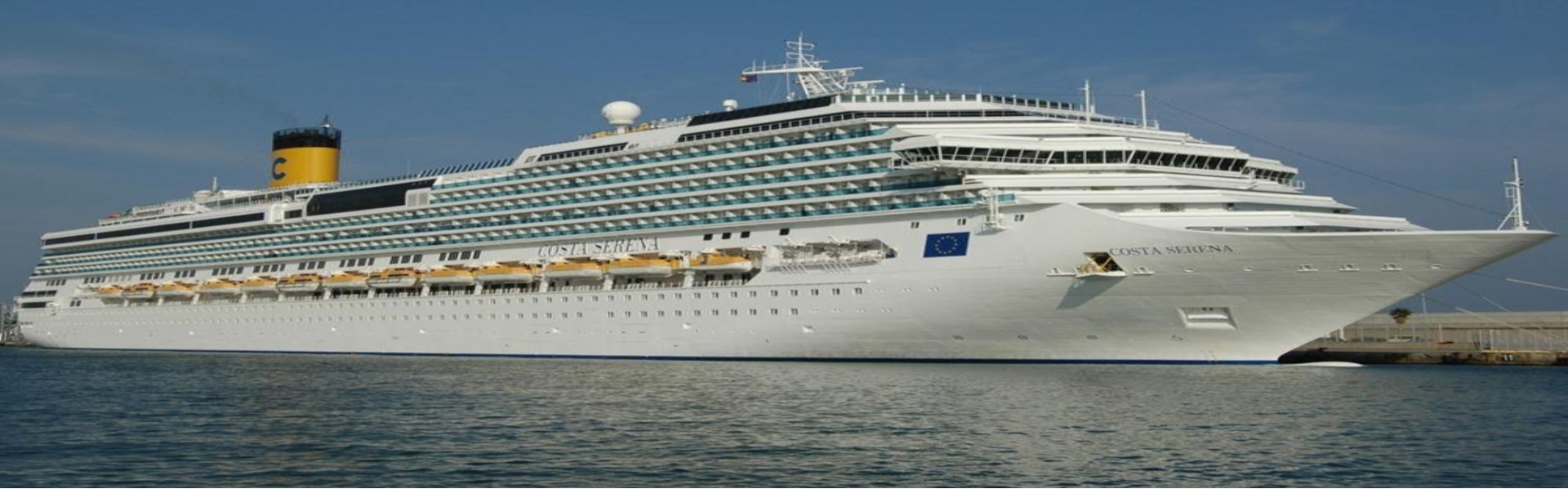
The Costa Serena entered service in May 2007. 289 metres, 1507 cabins, 3014
travellers at double occupancy. She is the oldest of the four ships in her
class, and she has just come out of an eighteen-day refit carried out in China
in autumn 2025: a new dining area, a restaurant with signed menus, a pizzeria,
a sushi counter, pool decks and suites entirely reworked. She is the last ship
in a five-year fleet revitalisation programme.
The point to check remains the class's: fewer than forty per cent of the
cabins have a balcony.
The most sellable cruise in the fleet
This ship ends a decade in East Asia in autumn 2026, with Taiwan, Korea and
Japan. She then leaves the region on a sixty-five-night repositioning cruise:
departure from Tokyo on 18 October 2026, twenty-four calls in fifteen
countries, arrival in Buenos Aires.
South America follows from December 2026 to April 2027, with Rio,
Montevideo and Buenos Aires, then the Mediterranean from May 2027. The current calendar appears on this page.
The other ships in the fleet
The Costa Pacifica and the Costa Fascinosa share her hull exactly. So does the Costa Favolosa, with a northern
programme. The Costa Diadema is the most accessible in the fleet.
The line, and what happened to it
Sixteen ships in 2019, eight today. Half the fleet left in six years: sold to
American, Chinese or British companies, transferred to other brands of the same
group, or cut up in a Turkish demolition yard. Of our seventeen Costa pages,
nine describe a ship the line no longer operates.
Costa was born in Genoa in 1854, in the olive oil trade. It has run ships
since 1924 and carried passengers since 1947. An American group took half of it
in 1997 and all of it in 2000. It is today one of the nine cruise brands in
that group, and its position there has weakened.
The wreck of 13 January 2012 off the island of Giglio killed 33 of the 4252
people aboard, including a diver killed during the salvage. The captain was
sentenced to sixteen years. It is from that wreck that the muster drill before
sailing comes, on every cruise ship in the world.
The fare, item by item
Included: the crossing, the cabin, meals in the main restaurants and the
buffet, shows, entertainment, the children's club and port taxes. Transfers are
included only when they are part of the package purchased.
Not included: air travel, insurance, drinks outside meals, excursions,
speciality restaurants, treatments and laundry. A drinks package exists and is
bought in advance or aboard.
The hotel service charge deserves a paragraph of its own. It is added to the
onboard account every day, automatically, and the North American contract calls
it mandatory. The amount depends on the traveller's age and on the region of
the world. It can be adjusted at the front desk, during the cruise only: after
disembarkation no change is possible.
Life aboard, unwrapped
This ship is a floating hotel rather than a destination. You go ashore every
day, come back for dinner, and the evening starts late. It is a European
format, and it suits anyone who wants to be in Europe from the moment they
board. It suits badly anyone looking for the continuous entertainment of a
North American line.
The unsettling points, said plainly: announcements in several languages in
turn, an evening buffet on European hours, wider tolerance of smoking than
here, a reduced daytime programme, and service more distant than on an American
line. In exchange, the crew-to-traveller ratio is around one to three, the
excursion catalogue runs past two thousand options, and the speciality
restaurants regularly exceed expectations.
Accessibility calls for care. No official table of adapted cabins is
published ship by ship; the available figures come from deck plans read by
third parties. They are indicative, not contractual, and any booking for a
traveller in a wheelchair is validated with the line before the deposit.
Leaving from Quebec
Air travel is booked separately. From Montreal, Rome, Barcelona and Athens
are reached non-stop for part of the year; Savona, Genoa, Kiel, Hamburg and the
Caribbean ports need a connection. A hotel night before embarkation is not a
luxury, it is the margin that absorbs a delayed bag.
On recourse, the situation deserves saying clearly. The carrier is Italian,
the contract provides for Italian law, and the competent courts are those of
Genoa, to the exclusion of all others. The contract also invokes the Athens
Convention, which caps liability for personal injury. This is not particular to
this line: most European cruise operators have equivalent clauses.
Nothing establishes a Quebec licence in the line's name. Voyages AquaTerra
holds that licence: trust account, Compensation Fund for Customers of Travel
Agents, and one file for flight, cruise, hotel and insurance.