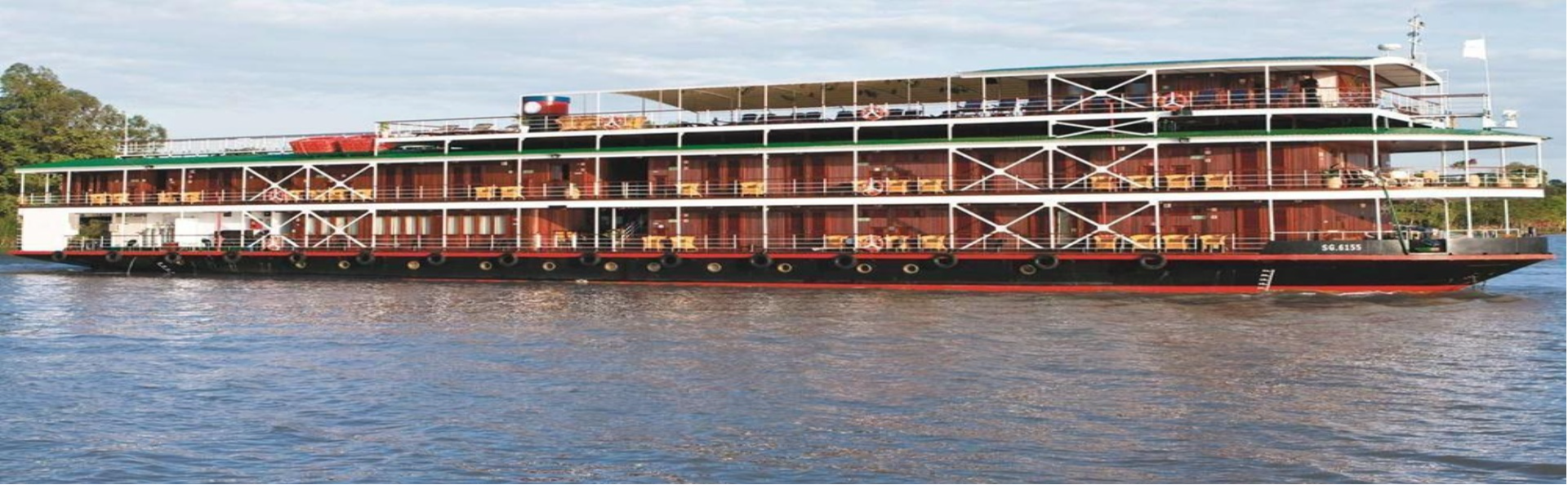
A chartered hull, handed back to her owner
The River Orchid worked the Mekong, between Vietnam and Cambodia, for this
brand. She no longer does. As on the Douro, the hull never belonged to the
line: she is operated by a specialist in Asian rivers, who charters her out.
The charter ended, the page stayed.
No withdrawal was ever announced. The ship simply vanished from the
catalogue, with no release, no note, no date. The Mekong programme is now
carried by the Mekong Jewel.
A small hull, and no balconies
Fifty-one metres, 29 cabins, 58 travellers, in service since 2013. There are
no balconies aboard and there never were: large opening windows in the cabins,
and a shared promenade where everyone ends up. On this river, air conditioning
and insect screens matter more than private outdoor space.
The Mekong sets its own rules. The level varies enormously between monsoon
and dry season, which changes the embarkation points and sometimes the length
of the land transfers. A November itinerary and a May itinerary are not alike,
even under the same name.
The other distant rivers
The Mekong Jewel took over the Mekong. The Ganges Voyager II works the Ganges. The Aria Amazon runs the
Peruvian Amazon. The River Tosca covers the Nile.
Who owns the hull
The line runs a mixed ownership model. It owns part of its fleet and
charters the rest from third-party shipowners, often without saying so in its
sales material. The difference shows the day a charter ends: the hull stays,
the name leaves the catalogue, and nothing is announced.
That is exactly what separates an owned fleet from a rented one. In the
first case a withdrawn ship is a sold ship and the sale can be traced. In the
second the ship never moved: the contract ended.
What is included, and what is not
Included: gratuities to the onboard crew, drinks served at meals, and at
least one excursion per touring day, those listed in the itinerary. Wi-Fi is
provided with no committed bandwidth; on European rivers it drops in gorges and
at locks.
Not included: the international flight, and gratuities to coach drivers
ashore, which remain at your expense. Transfers between the airport and the
ship are included only if the air ticket was bought from the line; bought
elsewhere, the transfer is paid separately.
Accessibility: what the line publishes
Almost nothing. It publishes no number of adapted cabins, on any ship in its
fleet. Its accessibility statement, the one linked in the footer, covers its
website only: it says nothing about the ships.
What it does write is plain enough. Anyone needing help must travel with an
able companion. Only a folding wheelchair is admitted aboard. Mobility scooters
are refused. And if the crew judges mid-voyage that a traveller can no longer
continue, that traveller is put ashore with no refund.
Booking from Quebec: the frame
Three legal systems overlap here. The river transport contract falls under
Swiss law, before the district court of Rheinfelden. The Canadian entity
answers before the Ontario Superior Court of Justice in Toronto, under an
Ontario permit. The American contract points to California.
Nothing establishes a Quebec licence for this line. Your protection
therefore comes from here: Voyages AquaTerra holds a licence from Quebec's
Office de la protection du consommateur, your payments move through a trust
account, and the Compensation Fund for Customers of Travel Agents covers your
file as the law provides.