This is not a cruise ship
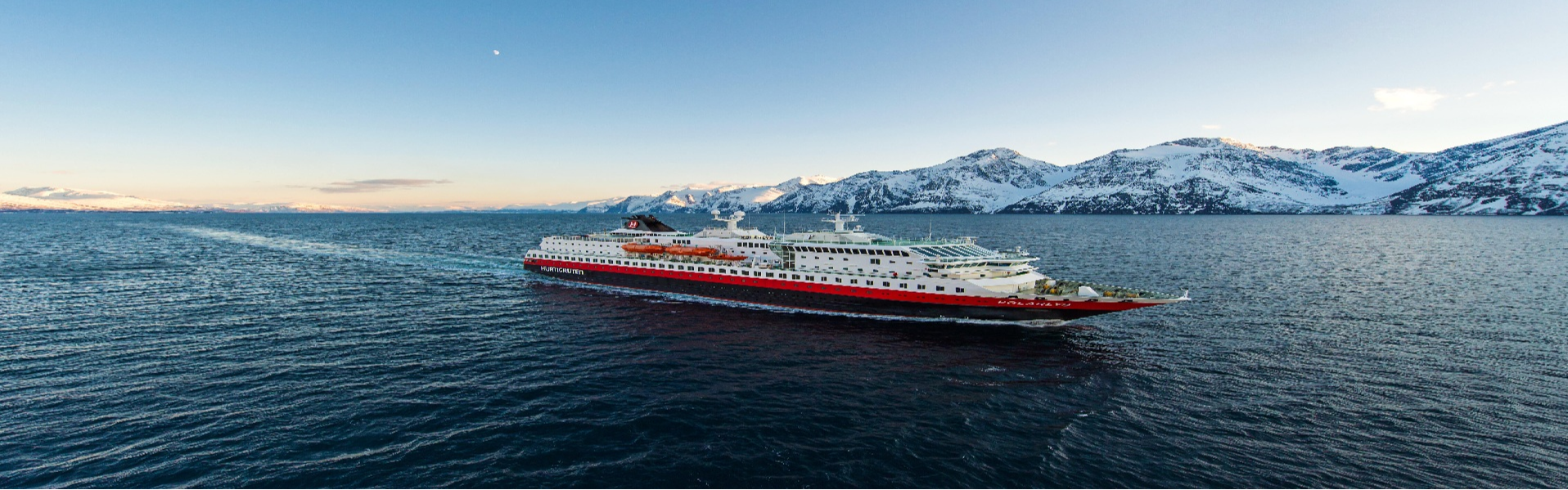
Start with what changes everything. MS Polarlys serves thirty-four ports between Bergen and Kirkenes, all year, in both directions. She carries twenty-six cars. She carries freight. She takes aboard locals who ride three hours to visit a sister and step off at the next quay. The coastal route has done this work since 1893, and the traveller who takes it joins a routine rather than watching one.
That costs something and it earns something. You will call at three in the morning at a port whose name you had never heard, with no announcement and no ceremony, because the mail does not wait. In exchange you will see a coastline nobody is staging for you.
The ship
She left the Ulstein Verft yard, in Norway, in 1996. Eleven thousand three hundred and forty-one gross tons, 123 metres by 20, seven decks of which six are open to guests, 225 cabins, 619 berths and 64 crew. A 2021 refit converted her to hybrid propulsion, with lithium-ion batteries and new engines. She carries three wheelchair-adapted cabins — one of the few lines in our catalogue to publish that figure, and it deserves credit.
What the fare covers
Breakfast, lunch and dinner in the Torget restaurant, tea, filter coffee and water through the day, Wi-Fi, and the expedition team's talks. Excursions are booked and paid separately. On gratuities and on alcohol the line says nothing in the coastal fare: we assert nothing either way, and your advisor will have it clarified before your deposit.
What the calendar sells
The departures on sale on this page run from 2026 to 2028. It is the largest ship page on this site. The lengths tell you everything about the nature of the service: three days ninety-eight times, four days sixty-five, then six, seven, eleven and twelve days about fifty-two times each. The short formats are segments — you board at one port and land at another. The eleven or twelve days is the full Bergen-Kirkenes-Bergen round trip.
Bergen recurs two hundred and fifty-nine times, Kirkenes one hundred and eighty-five, Trondheim one hundred and thirty, Tromsø one hundred and seventeen, Svolvær sixty-five. If you are after the northern lights, it is the northern segment that counts, not the total length.
What changed at the line
Hurtigruten and HX became two separate companies when acquisitions completed in February 2025, under a consortium of Arini Capital Management, Cyrus Capital Partners and Tresidor Investment Management. Hurtigruten keeps the Norwegian coastal route, this ship's route; HX runs expeditions elsewhere in the world. Both brands have a page on this site, and they should not be confused at booking time.
The other ships on the route
MS Richard With and MS Kong Harald run the same route and each carries a very full calendar. What separates them is the ship, not the itinerary: the age of the hull, the cabins, the dining room. The the line's own page explains the route as a whole.
No recorded incident, which is not the same thing
The Polarlys is the only ship on the route for which we found no grounding,
no fire, no major breakdown in the public sources. We write it as it stands: no
recorded incident. That does not mean there never was one, it means nothing is
published. The distinction matters as much as the fact.
One hundred and twenty-three metres, 211 cabins including 6 suites, out of
the Ulstein Verft yard at Ulsteinvik in 1996. Refitted in 2016 and again in
2023, with a diesel-electric and battery conversion completed at the end of
2023. Our inventory carries four hundred and thirty-seven dates: one hundred and
seventy-five in 2026, two hundred and twenty-nine in 2027 and thirty-three in
2028.
A detail that gives away what the ship is
She carries cars. Ten spaces from September to April, twenty from May to
August, with imposed maximum dimensions and weight. A cruise liner does not do
that. A coastal transport service does, because the contract expects it. The
same reasoning explains the fifteen-minute calls and the mandatory freight north
of Tromso.
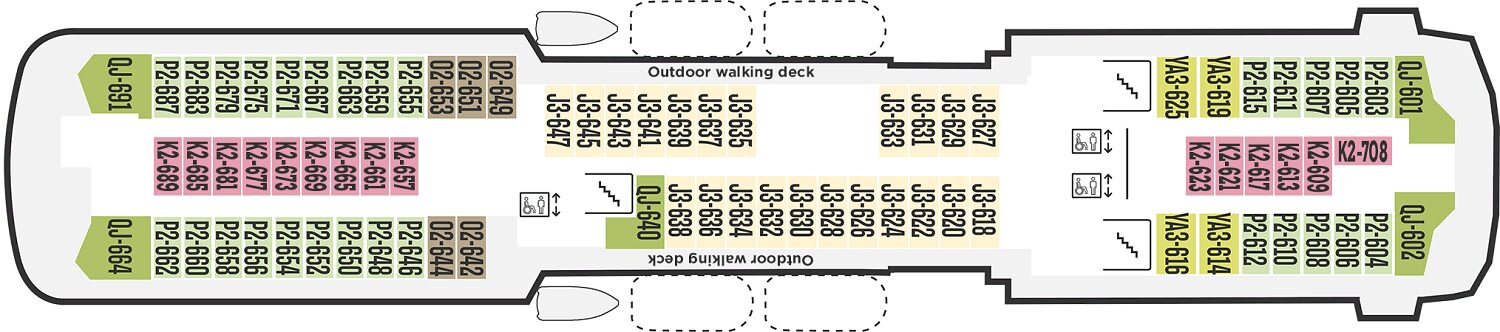
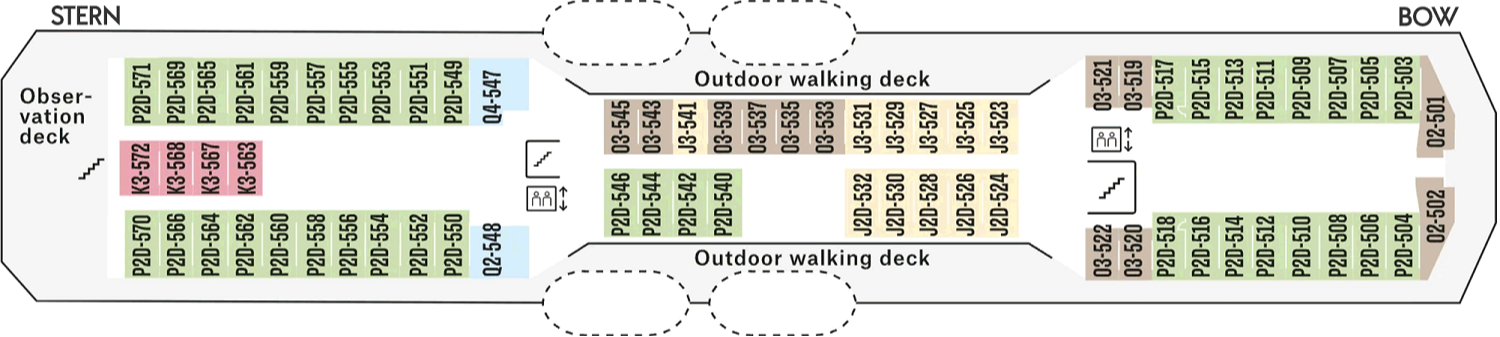
Three cabins are adapted for a wheelchair: 321, 323 and 325. The numbering
differs from her sister ships, which use the 331 to 335 series. Two accessible
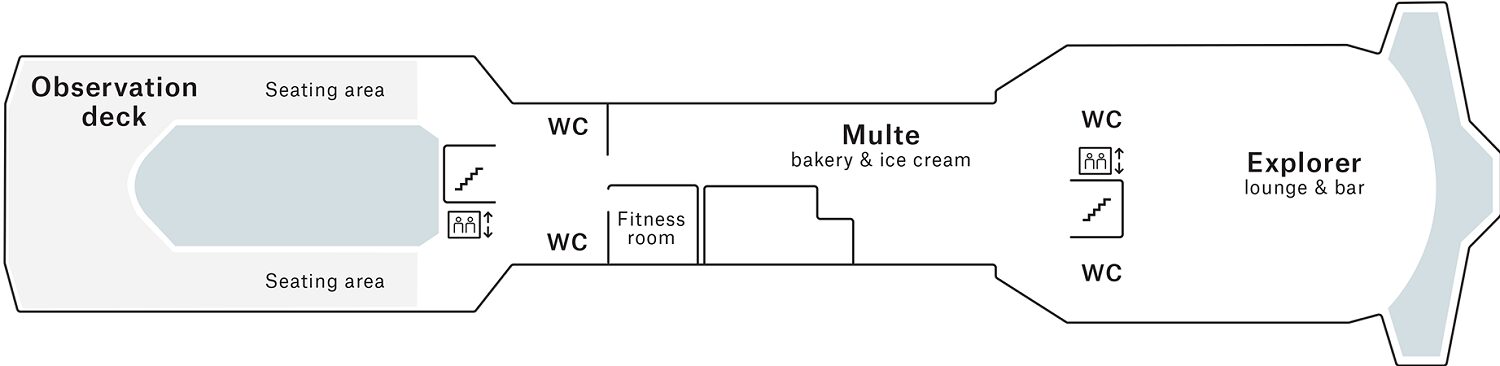
toilets sit on decks 4 and 7.
A transport timetable, not a cruise itinerary
What you buy here comes under a contract between the Norwegian state and two
shipowners, running from 2021 to 2030. It requires calls at every port on the
route every day of the year, freight carriage over the northern half, and a
guaranteed minimum of berths and pallets per ship. Heavy fuel oil is banned and
shore power connection is mandatory where it exists.
Hold on to this above all: the calls are set by the contract, not by tourist
interest. Fifteen minutes at some quays, three or four hours at the larger
ports, and eight night calls. And the contract is shared with Havila Kystruten:
the two companies alternate departure days, so a given date belongs to one or
the other. Your advisor checks which before booking.
Full voyage or segment ticket: two products
The full voyage includes full board in the main restaurant, with tea, filter
coffee and water. It does not include alcohol, excursions, transfers, flights or
gratuities. That last point deserves naming: they are not included here, unlike
the same group's expedition offer, where they are.
Port-to-port is sold as transport. Meals are not included, a cabin is
required only beyond twenty-three hours of sailing, its location is never
chosen and suites are excluded. As for Wi-Fi, the carrier gives three different
versions depending on the page you read: free, reserved for the higher fare, or
excluded. So we promise nothing.
Northern lights: what is promised and what is not
Nobody can guarantee a natural phenomenon, and the carrier does not claim to
either. What it offers is compensation if no aurora was observed, under strict
conditions: an eleven-day voyage minimum, a departure between 20 September and
31 March, and the higher fare, the entry fare being excluded.
The definition of a sighting is the heart of the matter. An aurora logged by
the bridge officers and announced on board is enough to extinguish the
guarantee, whether you saw it or not, and the ship's decision is final. The
compensation takes the form of a classic coastal voyage the following season, in
a two-berth inside cabin, to be claimed within twenty-eight days of return.
Reduced mobility: the rules before the brochure
A companion is required, and it is not a suggestion: the carrier writes it
for safety reasons. The crew provides no personal care, no lifting, no escort
between cabin and public areas. Mobility scooters are admitted provided an
adapted cabin is booked and they are stowed in the cabin, never in public
spaces.
Ashore, the reservation is major: the carrier states it offers no excursions
designed for wheelchair users and does not guarantee ramp-equipped coaches. Only
first-level excursions may be suitable. And it publishes no list of the calls
where quay access is impossible.
Where a dispute is heard
In Bergen, Norway, under Norwegian law. The contract provides no arbitration
clause: a dispute therefore goes before a court, and that court is Norwegian.
The limitation periods are one year for an ordinary claim and two years for
personal injury, counted from disembarkation.
No Quebec licence is established for this carrier. It is the agency that
brings the protection from here: a licence from the Office de la protection du
consommateur, a trust account separate from the firm's own funds, and the
Compensation Fund for Customers of Travel Agents. Those three follow a booking
made here, and only that one.