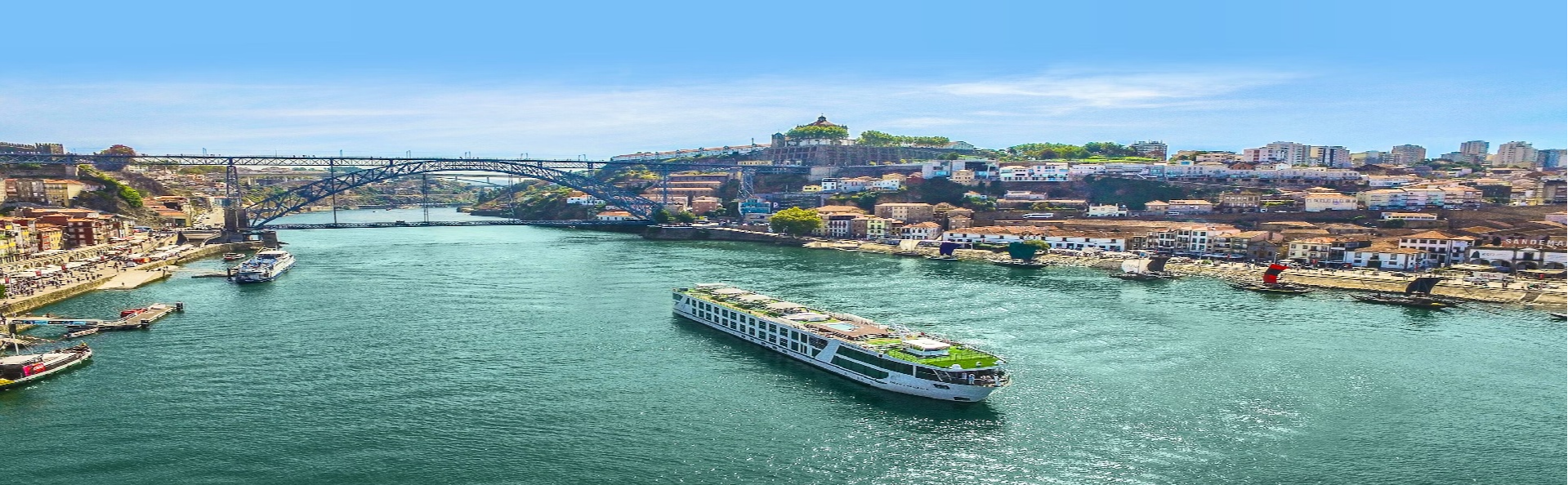
Eighty-nine metres on the Douro
The Emerald Radiance left the WestSEA yard at Viana do Castelo, in Portugal,
in 2017. She is the smallest European river hull of the fleet: eighty-nine
metres, four decks of which three carry cabins, 56 cabins and 112 travellers.
The Douro does not take large hulls, and it is the river that sets the
dimensions.
She sails between Portugal and Spain, on a river with several deep locks. Our calendar covers 2026 and 2027.
Two things this ship does not have
The pool does not convert into a cinema. It is this brand's most repeated
feature and it does not hold here: the upper deck pool stays a pool, unlike the
seven one hundred and thirty-five metre hulls. One database states the contrary;
the editorial source that visited the ship gives it explicitly as a drawback. We
keep the second.
There are no bicycles on board either, where the rest of the river fleet
provides them. On the Douro, where the quintas are often reached by winding
roads, the absence is less noticeable than elsewhere.
The ownership question
She is the only hull of the fleet whose ownership is not established. One
source attributes her to the Australian group alone; another writes that she is
shared with a Portuguese shipowner and operated by it. No primary source
settles it. The regulatory context of the Douro makes a local arrangement
plausible, but we do not assert it.
Reviews note circulation that congests quickly before excursions and at
meals, and bathrooms judged small. Lower deck cabins have a fixed panoramic
window.
The other ships in the fleet
The Emerald Liberté holds the Rhone. The Emerald Lumi joins the Seine in 2027. The Emerald Star and the Emerald Sun
cover the Rhine and the Danube.
An owned fleet, not a chartered one
The Australian group behind this brand does not rent its ships: it owns
them. Since 2020 it also owns a shipbuilder in Croatia, and it calls its own
the Vietnamese yard its yachts come from. The river hulls come from Dutch
yards, one of the most recent from Romania.
The difference shows the day a third-party shipowner takes a hull back for
its own brand, which does happen elsewhere in European river cruising. Here the
question does not arise in the same way.
The inclusions, and what not to transpose
The fare covers gratuities to the crew, the guides and the drivers, standard
drinks at meals, at least one excursion per touring day and internet access. On
the river ships, electric bicycles are available.
What it does not cover here: the international flight. Note that the same
brand's British offer does cover it, transfers included. It is the most common
confusion about this line, and it costs dearly when discovered at payment.
Reduced mobility: read this before booking
Able companion required. Folding wheelchair only. Mobility scooter judged
unsuitable. The line itself warns that cabin and bathroom doors may not be wide
enough for a standard wheelchair.
No number of adapted cabins is published for the river fleet, and on the
yachts the absence of an adapted cabin is established by two independent
sources. Add mooring abreast, common in Europe: the passenger on the outer ship
crosses the neighbouring vessel by narrow gangways and stairs.
The Quebec frame
This brand's contract is signed by an Australian company. No Quebec licence
is established for it. It is the agency that brings the protection: a licence
from the Office de la protection du consommateur, a trust account separate from
the firm's own funds, and the Compensation Fund for Customers of Travel Agents.
Those three follow a booking made here, and only that one.