There is no lift
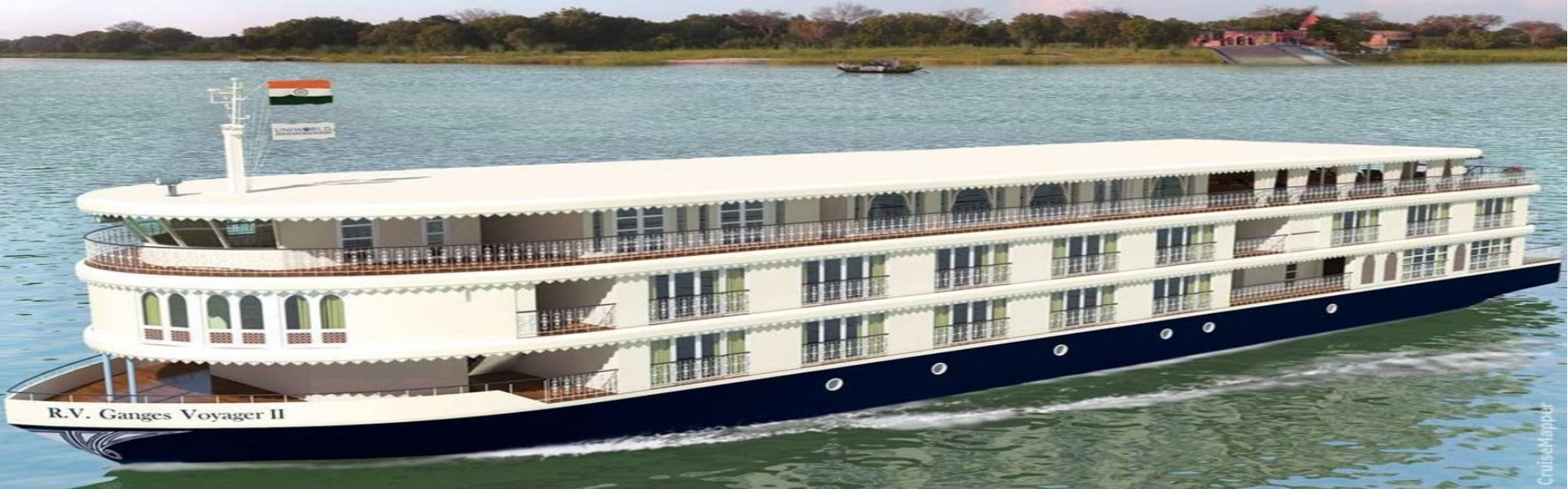
Start where the disappointment gets made. Ganges Voyager II has no passenger
lift. On a ship with three habitable levels, that means stairs several times a
day, some of them steep, with a handrail that becomes your best friend. A
seventy-five-year-old in good shape manages. A traveller nursing a knee or a
heart should think hard before paying a deposit.
Add what waits ashore. The ghats of Kolkata and the villages of Bengal are
visited by way of uneven stone steps, often wet. That is exactly what makes the
trip unforgettable, and exactly what makes it demanding.
The hull
Fifty-six and a half metres long, twelve and a half wide, 56 guests and 36
crew. The ship entered service in 2016. Its beam exceeds a typical European
river hull by about a metre, because the Ganges knows nothing of Rhine lock
dimensions. All 28 accommodations are suites, the smallest around twenty-four
square metres, each with a French or Juliet balcony.
The murals are hand painted. It is the kind of detail you read everywhere
without believing it, and that checks out the moment you walk into the cabin.
Fifty-six guests, and what that changes
On a river where cruise traffic remains rare, a hull this size berths where a
large ship cannot go. The journey happens in villages that receive dozens of
visitors at a time rather than hundreds. The exchange with residents is not the
same. The trade-off is accepting rudimentary mooring in places, sometimes a
plank laid on the bank.
The ship is staffed by 36 people for 56 guests. Note that this ratio belongs
to the Ganges and does not travel to the European rivers.
Elsewhere in Asia and on the Nile
If Southeast Asia appeals more, look at Mekong Jewel. On the Nile, Uniworld runs River Tosca and
S.S. Sphinx. And for a European cruise of another kind, S.S. La Venezia works the Venetian lagoon.
What the package covers
Shipboard gratuities are included. That is unusual, and it changes the end of
the cruise, which is normally spent working out envelopes. Meals are included,
along with a selection of wines, beers and spirits served through the day.
Scheduled excursions are included, as are the transfers written into your
file.
Wi-Fi is offered aboard as a courtesy, with no guaranteed speed. In locks, in
tunnels and along remote banks the connection drops. Treat it as a convenience
rather than a working tool.
You still pay for airfare, visas, travel insurance, laundry, spa treatments,
communications and optional excursions.
Inclusions differ outside Europe. Uniworld says so in its
own terms: on the Nile, in India, in Southeast Asia and in Peru, the package is
not the one that applies to the European ships. Have your specific departure
checked before you book, because the gap shows up as disappointment.
Reduced mobility, the plain answer
Uniworld commits to reasonable efforts and does not guarantee full
accessibility. The line supplies no mobility equipment, and a traveller who
needs help must be accompanied by someone able to give it. The gangway tilts
with the water level. Old towns are walked on cobblestones. Ask about the lift
arrangement on your specific ship before booking, because the answer changes
from hull to hull.
Booking from Quebec
You leave from Montreal, which adds a day at each end of the trip. The
transatlantic flight departs in the evening and lands in Europe the next
morning, six hours out of step with your body. Most travellers arrive the day
before embarkation and sleep a night on the ground. That night is the
difference between boarding rested and spending day one fighting sleep.
Voyages AquaTerra holds a licence from Quebec's Office de la protection du
consommateur. The money you pay moves through the trust account required by
law, and your trip is covered by the Compensation Fund for Customers of Travel
Agents. Your advisor gives you the documents that establish this protection.