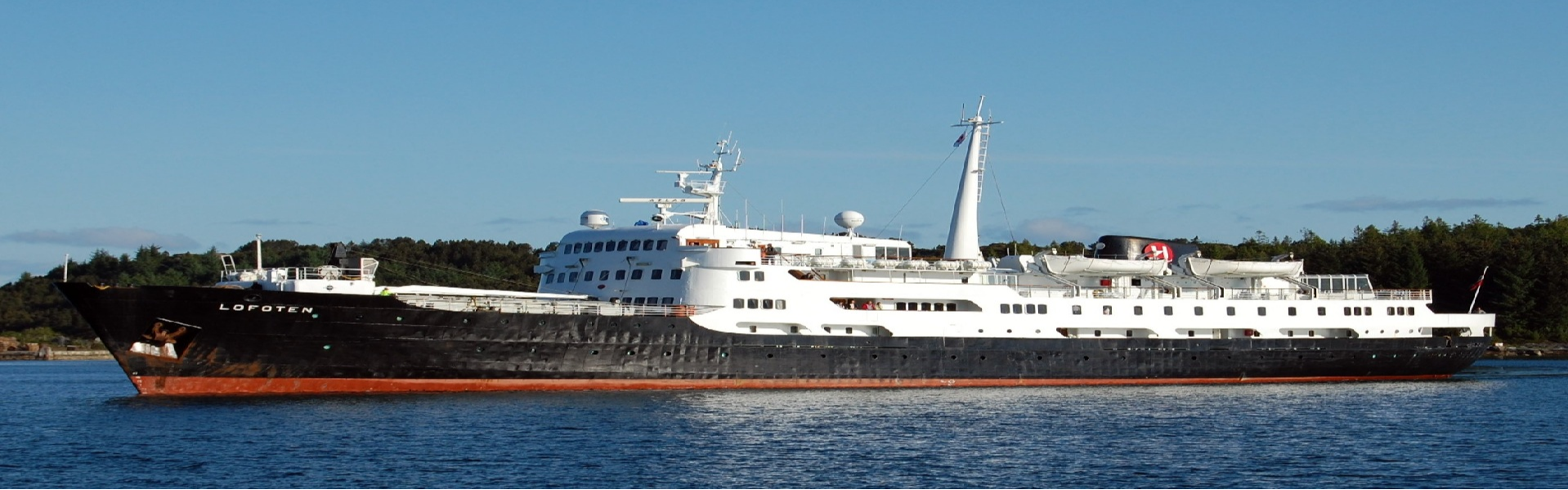
Withdrawn on 31 December 2020, now a training ship
The Lofoten left Hurtigruten service on 31 December 2020. She was sold and
today serves as a training ship for a Norwegian maritime school. She therefore
carries no departure dates and will carry none again.
She was the oldest hull in the fleet, by a wide margin. Named on 7 September
1963, entering service on 5 March 1964, she was listed as worthy of preservation
by the Norwegian heritage directorate in 2001. Her original 1963 engine still
turns. Four hundred travellers, 88 cabins, eighty-seven metres.
Why this page stays online
Because the name keeps being searched. This ship holds a particular place in
the history of the coastal route: she is the one enthusiasts came for, for her
age and for her machinery. A reader typing her name deserves to learn what became
of her rather than hitting an error.
She still sails, under another flag and for another purpose. This is not a
scrapped hull, it is a hull that trains crews.
The ships that carry dates
The MS Richard With carries the name of the route's founder. The MS Kong Harald is her twin from 1993.
The MS Nordlys suffered the 2011 fire. The la flotte au complet page brings them together.
The coastal route, and who really runs it
It is a public service route, created by government contract in 1893 to
carry the mail along the Norwegian coast. The current contract runs from 2021
to 2030 and requires daily calls at every port, mandatory freight between Tromso
and Kirkenes, and a minimum capacity per ship. The full voyage takes twelve days
and two thousand five hundred nautical miles.
Eleven ships provide the service, but they do not all belong to the same
company: seven to Hurtigruten, four to Havila Kystruten, with alternating
departure days. A traveller who books a date without knowing this can therefore
board a ship belonging to a different company from the one whose page they read.
It is the kind of thing better learned beforehand.
Included, not included, and it depends on the ticket
Included on the full voyage: the three daily meals in the main restaurant,
tea, filter coffee and water. Not included: alcohol, excursions, land transfers,
flights and gratuities. On that last point the same group's expedition brand claims the opposite, with an asterisk whose footnote is not published: check it before you compare.
The port-to-port ticket does not include meals: full board, half board or à
la carte are bought separately. A cabin becomes compulsory past twenty-three
hours of sailing. Wi-Fi is announced in three contradictory ways by the carrier
itself, depending on the page; we would rather say so than promise it.
Before setting out for the lights
The season runs from 20 September to 31 March, the guarantee requires a
voyage of at least eleven days, and it attaches to the higher fare only. Three
conditions, and they stack. A shorter voyage, an out-of-season departure or the
entry fare, and there is no guarantee at all.
Then comes the definition. A sighting means an aurora seen from the ship,
logged by the bridge officers and announced to passengers; the ship's decision
is final. In other words, a night announcement while you were asleep is enough.
If the guarantee applies, it gives a classic coastal voyage the following
season, two-berth inside cabin, suites excluded, to be claimed within
twenty-eight days.
What is written about accessibility, and what is missing
What is written: companion required, no personal care provided by the crew, a
central lift serving the main public areas, two to four adapted cabins depending
on the ship. The carrier adds that it offers no excursions designed for
wheelchair users and does not guarantee ramp-equipped coaches.
What is missing: the list of calls where access is impossible, never
published. And confirmation that the lift serves every deck, which the carrier
asserts nowhere. On one of its ships it even notes that some outer decks are
reached by stairs only and that the pool has no lift.
The legal frame
Norwegian law, the court of Bergen, no imposed arbitration. Liability for
personal injury is capped under the international maritime conventions, as with
most European carriers. The deadlines are tight: one year to claim, two years
for personal injury.
Nothing establishes that any entity in this group holds a Quebec licence.
Voyages AquaTerra holds one, with the trust account and the Compensation Fund
for Customers of Travel Agents that go with it. A booking made elsewhere does
not carry that protection.