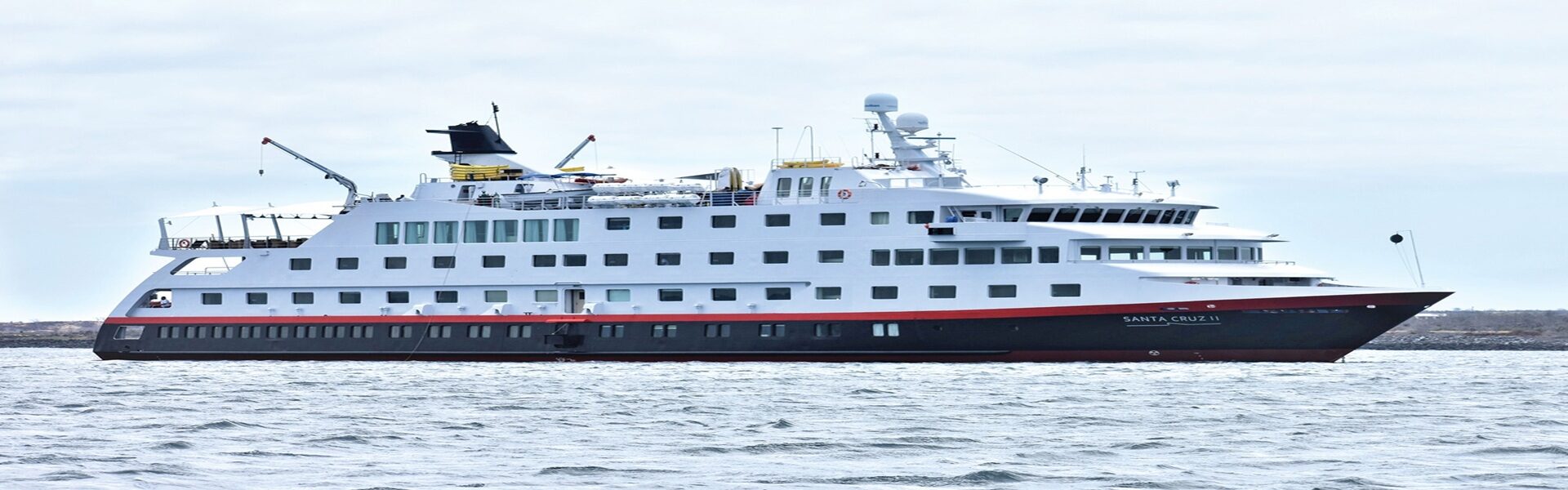
A Patagonian hull turned Galápagos ship
The Santa Cruz II left the ASENAV yard in Valdivia, Chile, in 2002.
She was called Mare Australis then, and carried travellers through the
channels of Patagonia, where the wind rises without warning. Her hull
was drawn for those waters. She measures 71 metres, 2,664 gross tons,
and sails today under the Ecuadorian flag at a cruising speed of about
13 knots. The 2021 refit reworked the interiors and left intact what
gives the ship its value, a hull built for a rough sea.
The ship belongs to Metropolitan Touring
The distinction matters when you book. Metropolitan Touring, an
Ecuadorian company, owns and operates the Santa Cruz II.
Tauck buys space aboard and has paired
her with its programme since 1998. You will therefore share the ship
with travellers who booked through other brands. Tauck says so in its
own literature, and we would rather tell you before departure than at
the gangway.
What Tauck adds is its own shore excursions and one Tauck Director
for roughly every forty of its guests. The same hull also sells under
the HX banner, which is why the same
ship turns up in two places when you search for her online.
Fifty cabins for ninety travellers
Five decks, fifty cabins, every one with an exterior window,
adjustable air conditioning and a safe. Metropolitan Touring sorts them
into four categories: two Voyager cabins built for the solo traveller,
forty-three Explorer cabins, two Explorer Family cabins and three
Darwin Suites. Thirty-six cabins interconnect, which settles the
question of families without sending anyone to sleep at the far end of
the ship.
The public rooms are quickly listed: an observation lounge with a
bar, a sky bar, a library, a fitness room, a shop and two hot tubs. A
medical officer stays on call at all hours.
What happens in the water
The ship carries a glass-bottom boat, kayaks and paddleboards.
Snorkelling gear and wetsuits travel aboard and are made available to
you. Landings are made by inflatable, often with your feet in the
water. That is the normal way to reach land in the Galápagos, and it
means stepping over the tube of a boat that is moving.
What the rules require
The archipelago is a national park and a marine reserve. Every
visitor pays an entrance fee on arrival, in cash, and obtains a transit
control card before boarding in Quito or Guayaquil. Ashore, groups stay
with naturalist guides certified by the park, and trails are walked in
single file, between the markers. These rules explain the small size of
the ships allowed here and the steady pace of the days.
What we could not establish
The number of naturalist guides aboard varies by source, from four
to seven. Public documents stay silent on whether a wheelchair-
accessible cabin exists, or whether a lift serves the five decks. A
traveller with
reduced mobility should ask before booking. We will ask on their
behalf.
Who this ship suits
She suits the curious traveller who accepts a full programme, early
mornings and two outings a day. She suits less well anyone looking for
a large ship, a casino, an evening show, or the freedom to stay aboard
doing nothing for a week. The Galápagos are visited on foot and in the
water.
To compare ways of seeing the archipelago, see
Lindblad Expeditions and the
Celebrity Flora.