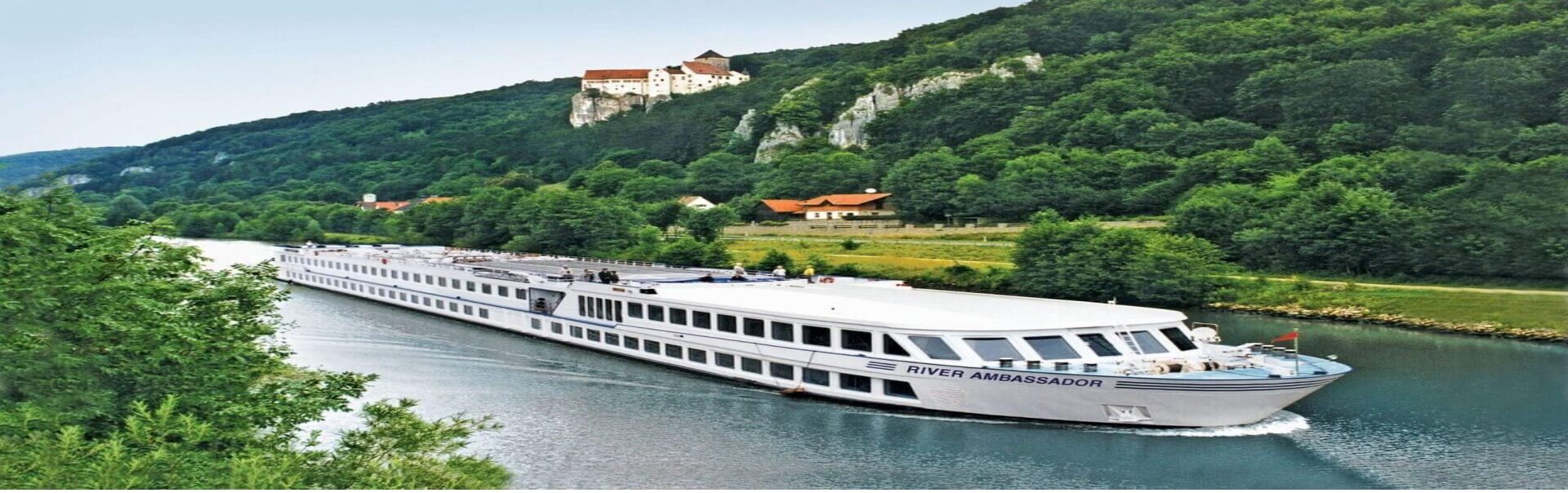
Renamed THE A in 2018, and then nothing
The River Ambassador left this marque in 2018. The hull moved to a young
brand within the same group, which renamed her THE A and aimed
her at a broader, more festive clientele. That brand has since been shut
down.
Where the hull is in 2026, who operates her and under what name: nothing is
published. It is a blind spot and we write it as such rather than inventing an
ending. One thing is certain, she no longer sails for the brand whose page you
are reading.
A 1993 hull
Built at the De Hoop yard, Lobith, in the Netherlands, in 1993, rebuilt in
2011. One hundred and ten metres, 60 cabins, 128 travellers, on the Rhine and
the Danube. She was already among the oldest European units in the fleet when
she left, and her age explains much of that departure.
The detail worth keeping: between building and the change of marque, this
hull served twenty-five years. European river cruising keeps its ships far
longer than ocean cruising does, because fresh water does not attack steel the
way salt water does.
Where to sail today
The S.S. Elisabeth works the Rhine. The S.S. Emilie is the brand's fiftieth anniversary ship, on
the Danube. The S.S. Victoria adds the Mosel to the Rhine. The S.S. Marlene also covers the
Danube.
Who owns the hull
The line runs a mixed ownership model. It owns part of its fleet and
charters the rest from third-party shipowners, often without saying so in its
sales material. The difference shows the day a charter ends: the hull stays,
the name leaves the catalogue, and nothing is announced.
That is exactly what separates an owned fleet from a rented one. In the
first case a withdrawn ship is a sold ship and the sale can be traced. In the
second the ship never moved: the contract ended.
What is included, and what is not
Included: gratuities to the onboard crew, drinks served at meals, and at
least one excursion per touring day, those listed in the itinerary. Wi-Fi is
provided with no committed bandwidth; on European rivers it drops in gorges and
at locks.
Not included: the international flight, and gratuities to coach drivers
ashore, which remain at your expense. Transfers between the airport and the
ship are included only if the air ticket was bought from the line; bought
elsewhere, the transfer is paid separately.
Accessibility: what the line publishes
Almost nothing. It publishes no number of adapted cabins, on any ship in its
fleet. Its accessibility statement, the one linked in the footer, covers its
website only: it says nothing about the ships.
What it does write is plain enough. Anyone needing help must travel with an
able companion. Only a folding wheelchair is admitted aboard. Mobility scooters
are refused. And if the crew judges mid-voyage that a traveller can no longer
continue, that traveller is put ashore with no refund.
Booking from Quebec: the frame
Three legal systems overlap here. The river transport contract falls under
Swiss law, before the district court of Rheinfelden. The Canadian entity
answers before the Ontario Superior Court of Justice in Toronto, under an
Ontario permit. The American contract points to California.
Nothing establishes a Quebec licence for this line. Your protection
therefore comes from here: Voyages AquaTerra holds a licence from Quebec's
Office de la protection du consommateur, your payments move through a trust
account, and the Compensation Fund for Customers of Travel Agents covers your
file as the law provides.